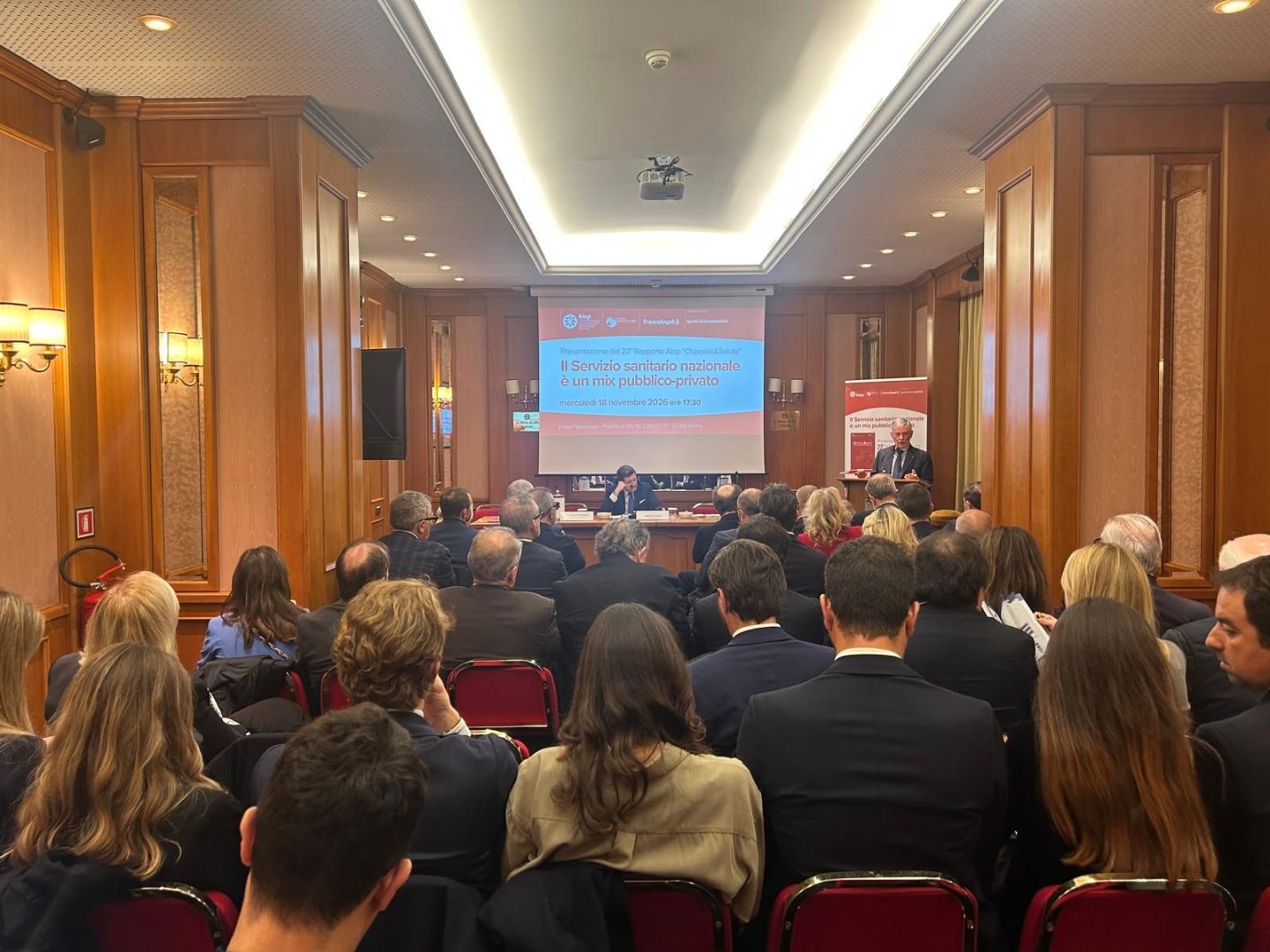
ROMA (ITALPRESS) – The official presentation of the 22nd “Ospedali&Salute” Report was held in Rome, created by AIOP (Italian Association of Hospital and Territorial Health Companies and of Residential and Residential Health Companies) with the collaboration of Fondazione Sanità Futura and edited by FrancoAngeli, with the moderation of the Vice Director Andrea del Tcani. The Minister of Health, Orazio Schillaci, opened the works with a video message: “The Report is not only a means of monitoring and knowledge of the health offer, but also an important opportunity to reaffirm the fundamental role that the private partner plays within the health care network. The data contained in the Report confirms a truth that should be acquired, being foreseen also in the law establishing the National Health Service: the private partner integrates, without replacing it, the public sector and contributes to strengthening the ability of the system to respond to the health needs of citizens”, said the Minister, who then continued affirming that the common goal is “to guarantee citizens prompt and appropriate responses, because citizens do not look at the legal nature of the structures, but they receive appropriate answers. With this awareness, we have predicted that all public and private tenders should contribute to booking systems,” added Schillaci, pointing out that “the latest data from the Agenas platform give us a significant increase in services provided that confirm that this is the right way. In time of financial manoeuvre – he concluded – it is necessary to reiterate that all the measures present in the Law of Budget, including those that involve also the private contracted, like updates of hospital rates or the possibility of increase of performance from the structures agreed, are always and exclusively aimed to guarantee more effective and timely answers to our citizens”. Gabriele Pelissero, National President of AIOP, explained the meaning and the main results of the volume: “It’s time to overcome the ideological narrative that contrasts public and private: public service is all that is made available to citizens under general taxation,” Pelissero said. “The data of the 2nd Report disproves those who reduce us to simple performance: the accredited private guarantees over 30% of total beds, with tips of 76% in rehabilitation and 58% in long-term care, and assures 28% of total shelters and 36% of the outpatient specialist, including 42% of instrumental diagnostics and 36% of laboratories. It is also crucial in high complexity, where it achieves almost 30% of total cardiosurgery, over 63% of orthopaedics and about 25% of oncological surgery. It is proof that, for volumes and outcomes, the accredited private plays an essential role: we are not an alternative or a competitor of the public, but an integral part of the National Health Service. We are the two legs of the same system: if one weakens, everything collapses.” The technical and spatial analysis was illustrated by Alice Basiglini of the AIOP Study Office: “Through the analysis of validated sources, we represented the real form of the National Health Service, as a structurally mixed, public and private accredited system. Not only does Ssn’s private law component guarantee more than a quarter of hospital shelters and more than a third of outpatient services, it ensures treatments and interventions of greater complexity and quality. To confirm this, an average weight of 1,52 is recorded against 1,36 of the public sector, while the results of the treatments and interventions provided by the instrumentsaccredited private ttures are better in almost all Agenas indicators, with ratings higher than standard in 67% of cases, than 55.5% of publics. All this, with a funding that since 2005 has always absorbed the same percentage of public resources, amounting to approximately 20%, while the resources for the purchase of services from public facilities has gone from 55% to 62% of the total. The results of the volume were prelude to the round table “Private in SSN, suppliers or partners?” The debate included Luciano Ciocchetti (Vicepresident Commission Social Affairs, Chamber), Francesco Zaffini (President Commission Social Affairs and Health, Senate), Marco Osnato (President Finance Commission, Chamber), Ilenia Malavasi (Commission Social Affairs, Chamber), Davide Faraone (Commission Budget, Chamber) and Andrea Costa (Responsible Health Noi Moderati). A cross-recognition to the indispensable role of the accredited private law component, indicated as one of the two cornerstones on which the National Health Service stands, emerged from the confrontation between the majority and opposition representatives. Despite the diversity of political sensibilities on the instruments to be adopted, the speakers shared the need to strengthen the synergy between the public and private in harmony with the principle of subsidiarity, reasserting that public service is defined by the quality of care offered to citizens and not by the legal nature of the dispenser. On the operational front and the Budget Law 2027, the debate highlighted the need to complete the single CUP by integrating public and private agendas to break down waiting lists. In addition to the updating of the hospital rates – for which additional 500 million are expected – the need for a vertical revision of the DRG and the overcoming of the current spending roofs, indispensable to avoid a contraction of the care volumes, together with a greater focus on prevention, supplementary health and efficiency in the use of resources. – photo office stamap AIOP –(ITALPRESS).