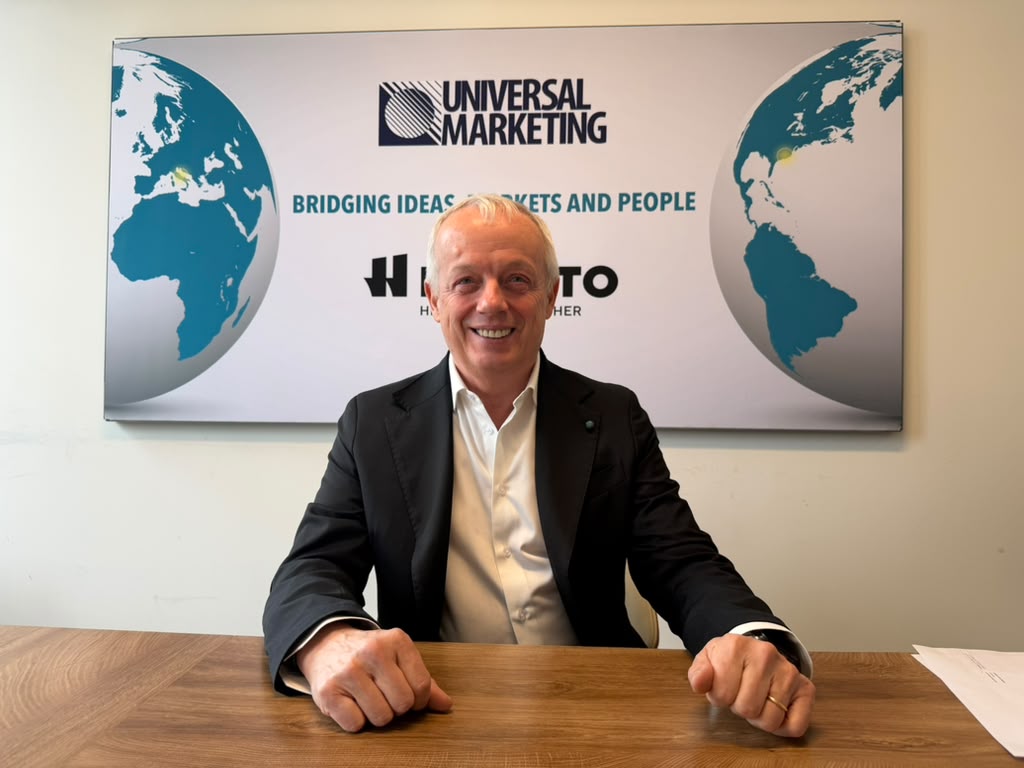
An exhibition stand, an Olympic pavilion, a space built to last only a few days: for Giovanni Giuliani, the challenge is always the same: to transform an environment into an experience able to immediately communicate the identity of a brand. The time to conquer the visitor is short, often a matter of seconds.
Giuliani, head of Henoto, a company of the BolognaFiere group specializing in temporary installations and architectures, tells the path that brought a small unit started in 2008 to operate internationally, between Europe, the United States, Mexico, the Middle East and Asia. In New York, during the New York podcast dedicated to business, retrace group growth, organizational challenges, the role of sustainability and differences between the Italian and American markets.
Giuliani indicates the principle that guides his work: the ability to surprise with a space, without losing the precision necessary to realize it. A balance between inventiveness and organization that also accompanies expansion in the United States.
How do you build an enterprise that lives in temporary spaces?
Our company was born from a small reality within BolognaFiere and, over time, has aggregated other companies of the territory. The challenge was to put together different skills and entrepreneurial stories, until we build what we today consider the largest Italian group in the industry. We want to help customers represent their products through a marvel effect: a space must hit in a few seconds and immediately convey an emotion.
What can Henoto offer to Italian companies that want to grow on international markets?
We are an Italian company, but we work in many parts of the world: in the United States, Mexico, Dubai, China, Vietnam, Europe, and we are developing our presence in India. We can accompany companies with local structures and organizations, in countries where they need to present their products.
Pandemic stopped live events. How did you deal with that stage?
Our work is based on contact between people, customers and suppliers. During Covid that contact had become impossible and the industry had practically zeroed. We tried to strengthen the international presence, taking advantage of the fact that restrictions did not affect all markets at the same time. We have also diversified, creating for example small spaces for hospitals, thanks to our ability to quickly build.
From a small unit to an industrial group: how do you grow without losing the attention of details?
The greatest difficulty is to build a managerial structure capable of accompanying fast growth. We try to value the internal resources and the professional heritage of each one, also favoring the growth of people on the managerial level. We are now an industrial reality, but we must preserve what characterizes the small business: closeness to the customer and attention to detail, aspects that I consider part of our Italian way of working.
How much does the cultural context matter in designing a space for a brand?
The space must be born from the needs of the customer, from the story he wants to tell and from the product he wants to present. But that story always passes through the cultural context of the place. Making a stand in America or China is very different from doing it in Italy: you need to understand which message is best suited to each market.
What changes when working at great sports events such as the Olympics?
In large events, the amount of work is enormous and needs an organizational, personal and media capacity, of a higher order of magnitude. We are also gaining experience in appointments such as the International Golf and the Davis Cup in Bologna. In the Winter Olympics, I am especially thrilled to have completed and delivered the work well and in the expected times, despite the snow and the difficult conditions.
What is the most common mistake of companies that internationalize?
Think that the working method used in your country automatically works everywhere. Each market has different rules, habits and mechanisms. We must enter with respect, understand how the context works and only after intervention. The right method in Italy is not necessarily the right method in the United States.
What is the difference between setting up a fair in Europe and one in the United States?
In the United States, setups often have less physical complexity, but transport and construction are more complex, also because rules can change from one state to another. In Europe, however, the regulations are on average more uniform and it is easier to operate with their own workers.
How is a sector more sustainable that builds structures destined to be dismantled?
The first step is to use recyclable and reusable materials, reducing the impact of setups. The theme of transport remains: our presence on multiple territories allows to shorten distances, avoiding always starting from the same operating center. We are also working to compensate for the residual part of the impact linked to logistics.
How do you imagine the future of fairs and what role will new technologies play?
Covid reminded us how important direct contact between companies, customers and suppliers is. I believe that technology and artificial intelligence must foster this relationship. We are already adopting artificial intelligence tools to simplify design and realization, but maintaining a fundamental human component.
Is there an event format that is underrated today?
I think of the small events of proximity, also organized for large brands and directed directly to consumers. These are opportunities to create an immediate encounter between the public and the product. They are not widespread yet, but they are beginning to develop.
How does Universal Marketing work?
We met three or four years ago and identified a common path. Universal Marketing is a very strong service platform to accompany customers in international growth. We contribute with our expertise to the realization of the installations.
Why should an American brand choose Henoto instead of a local company?
Our strength is to unite the Italian spirit to the American mentality in execution. We like to imagine new solutions, look for the idea able to surprise and give character to a space. But then we work in a methodical way, with a rigorous organization, attention to the times and orientation to the result: an approach we have learned to develop also working on the American market. To this are added the international presence, the sustainability of solutions and the relationship of trust with customers. It is not enough to have a creative intuition: it is necessary to know how to achieve it accurately.
A great project that dreams of building in the United States?
The Olympics. It would be an extraordinary achievement for Henoto, a project that we would really like to achieve in the United States.
L’articolo Giovanni Giuliani: the growth of Henoto between creativity and great events proviene da IlNewyorkese.