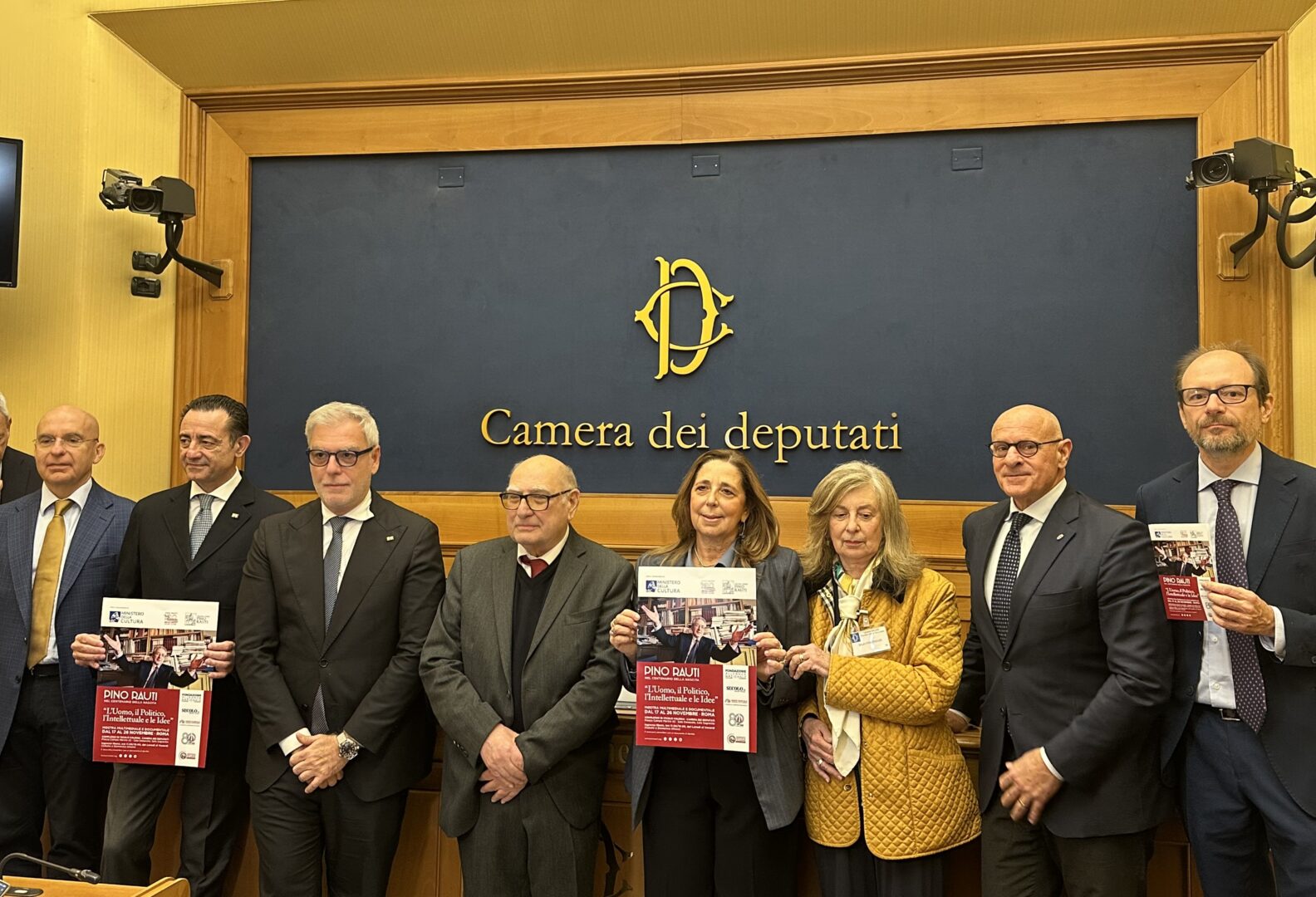
ROMA (ITALPRESS) – A documentary, biographic and multimedia exhibition and a volume dedicated to its parliamentary activity to remember Pino Rauti in the centenary of birth. The Chamber of Deputies will host from 17 to 26 November, in the complex of Vicolo Valdina, an exhibition dedicated to the historical exponent of the Italian right. On 19 November, the day of the event, in the Sala della Regina di Montecitorio will be presented a volume of the House’s necklace with a selection of its parliamentary interventions, the National, European Parliament and the Council of Europe, as well as some extracts of its political speeches.
“We are not improvising a celebratory event, even if it is necessary, but end to itself. I believe there is a path and I expect more from the results of this centenary: a reinterpretation of what my father left, which is really a cultural, intellectual and political field,” said Isabella Rauti, Secretary of Defense and daughter of Pino Rauti, during the press conference at the Chamber of Deputies.
“Some elements of his thought, which were matured in the 1970s and 1980s, dealt with issues that are current today: migration and demographic issues, new poverty, human costs of wild capitalism. Perhaps it was such a long thought and a vision so prospect to be sometimes present in its time – he continued -. I don’t expect what has left us give answers to all the questions of the present, but the attentive reader can find reading keys to interpret today’s complexity.” Isabella Rauti also remembered the work of preparation of the initiatives and the fund dedicated to the father constituted in 2020 at the National Library, thanks to a donation of her and her sister Alessandra, with about three thousand volumes of the personal library and numerous archival units. On November 19, a commemorative postcard will be unveiled by Poste Italiane.
“Pino Rauti was a great thinker first. He was a transformer, a modernizer, a stimulus for many young people of my generation who were drinking at the source of his innovative ideas,” said the Vice President of the Chamber Fabio Rampelli, underlining that “in the imagination there was another idea of Pino Rauti, totally different from reality. The image that was left in inheritance is, in my opinion, mainly distorted. Rauti has had the ability to put on the field innovative cultural trajectories, to discover new authors and to feed a debate that has crossed generations”.
Rampelli recalled Rauti’s contribution to ecology, sociality and peripheries: “Some know that ecology, as science and as a political and cultural affiliation, has found in the right and in particular in the Italian Social Movement an important processing ground, with Pino Rauti. What was missing was how to make ecology become something cooperative, how to give an organizational aspect to this desire for sociality, attention to the weakest bands and peripheries”, he concluded.
“This is first of all a cultural initiative on a protagonist of Republican history. Rauti was a politician, but it was also an intellectual end,” said the President of the Commission Culture of the Chamber, Federico Mollicone. “The magazines and study centers were cultural growth laboratories for entire generations, at a time when the parties were developing before communication. In those years dialogue was often expressed with lead, and those cultural experiences played an important role,” he continued.
“The method is starting from sources and not from labels or belongings. It is necessary to keep historical analysis distinct from personal, moral and summary judgment: to historicalize without absolute and without manipulating.” Mollicone also recalled Rauti’s parliamentary activity and its ability to anticipate issues that have become central: “I think of the environment, which he already spoke about in 87 to the Council of Europe, immigration and social issues.”.
He also recalled the relationship with Pietro Ingrao: “Two heretics, two strong characters, with a mutual estimation also in the clashes that are found in the Chamber’s classroom minutes.” “He struck me his extraordinary curiosity and listening skills. He wanted to understand, to know how the life of that Municipality was,” is the memory of Paolo Trancassini, the House’s commissioner, who told his meeting with Rauti during a summer stay in Leonessa, when he was local administrator.
“I was trying to be quick because I didn’t want to disturb his rest, but he asked me a lot of questions. He gave me the feeling, indeed the certainty, to find me in front of a really curious person, with an extraordinary ability to listen”. “I knew a little more about it I discovered a very great character of culture, but above all a man of extraordinary coherence and respect for opponents.” Trancassini added: “I believe that even for this reason it is worth the House to celebrate the hundred years of this extraordinary character of the Italian right”.
“We were proudly minority, but we said so many things,” said the editor and MP Alessandro Amorese, who recalled Rauti’s ability to anticipate political themes and transformations. “He had prophesied the end of real socialism and explained to us some of the social reasons that as Brothers of Italy we have welcomed.”.
“If on the right we have talked so much about cities, suburbs, defense of historical centers, the protection of cultural and architectural heritage and the defense of handicrafts, many of these ideas also come from the insights of Rauti and his magazines.” Amorese also recalled the reflections on the urban suburbs, defined by Rauti “fabbriche di nevrosi”, and the Hobbit fields:
“They were all but paramilitary camps, as they were told by those who did not set foot. Those who had the curiosity to enter found a colored world, talking about ecology, agri-food, rurality, fantasy and culture.” In the course of the conference, Rauti’s attempt was finally recalled to take the right beyond the traditional post-war borders, through what was called the “left foundation”, with greater attention to the world of work, to the most fragile social bands and peripheries. The programme of the centenary, which includes institutional, cultural and associative initiatives in different Italian cities, will continue in 2027.
-Photo xc7/Italpress-
(ITALPRESS).