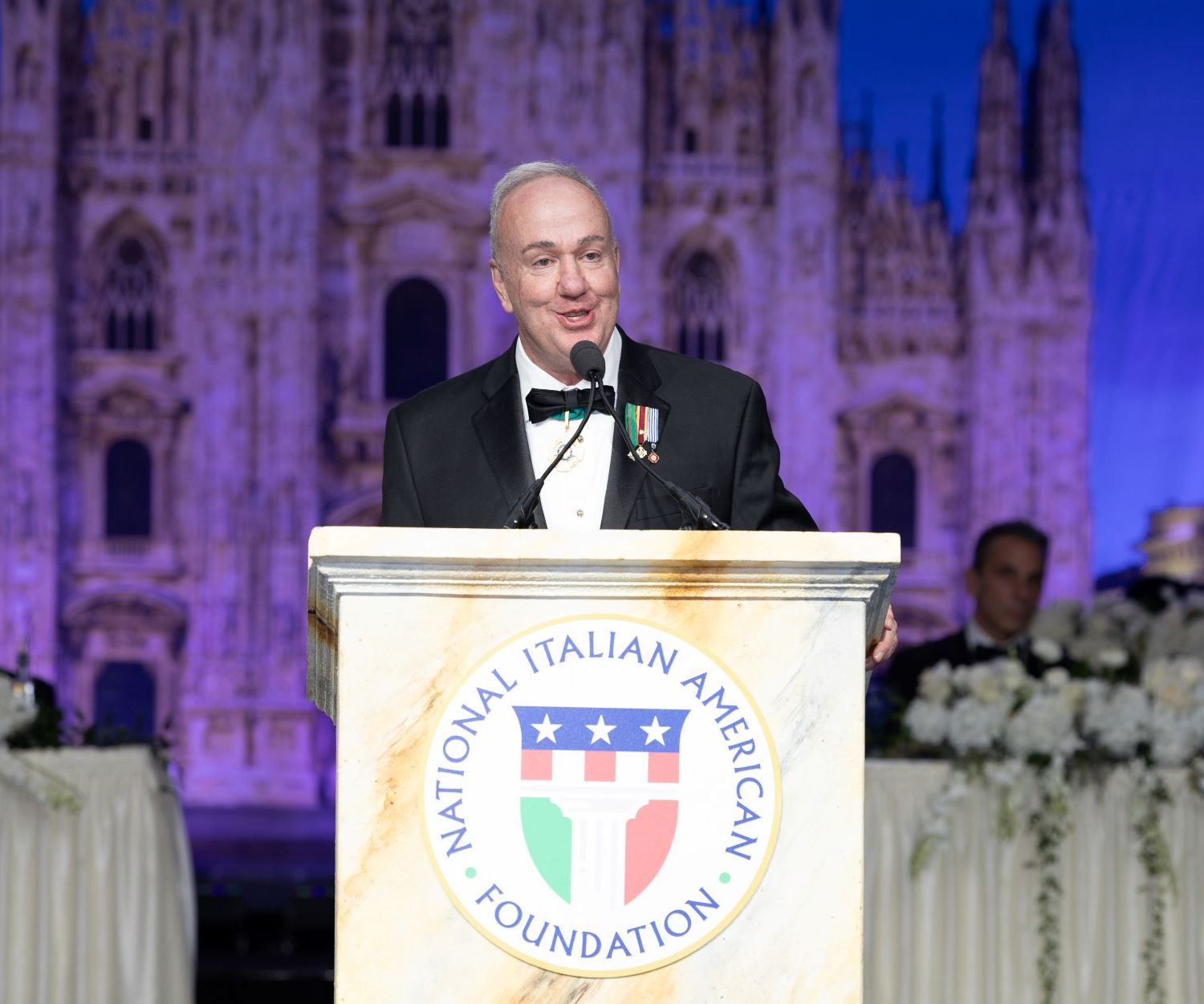
Fifty-one years are enough for an institution to build its own history. They are also sufficient because the community that represents changes around it. For the National Italian American Foundation, today the challenge is not simply to preserve what the Italian American community has been, but to define what can become.
Robert Allegrini, president and CEO of NIAF, talks about this evolution with the naturalness of those who understand both the weight of the past of the organization and the need to keep looking forward. The Foundation was born in 1975, at a time when defending Italian Americans from caricature representations and diffamation was an urgent part of its mission. Today Allegrini attributes to NIAF a different role: a meeting place, a cultural bridge, a voice in political debate and, more and more, a platform that brings together a new generation of Italian Americans with contemporary Italy.
Questa intervista fa parte dello Speciale 51 anni NIAF, distribuito durante il gala per i 51 anni della fondazione – anche per questo parla al futuro
This evolution will be visible on October 17, when the NIAF will meet at the Washington Hilton for the gala of its 51st anniversary. The evening arrives after the celebrations of the 50th anniversary, a historic event that recalled over 2,000 guests and saw the participation of the master Andrea Bocelli. Allegrini remembers it as a year when the Foundation did things great. For 2026, the symbolic meaning is different but not less important: the gala will celebrate the 250th anniversary of the United States and pay homage to Lombardy, chosen as the NIAF Onore Region.
The broader message, however, does not run out on an anniversary or on a single evening in Washington. For Allegrini, the gala is another occasion to make visible something that considers fundamental: the solidity of the relationship between Italy and the United States.
NIAF invited US Secretary of State Marco Rubio and Vice-President of the Italian Council and Foreign Minister Antonio Tajani. At the time of the interview, neither of the two appearances had been confirmed, but according to Allegrini their participation would be a strong symbol of solidarity between the two countries.
This report is also expressed through the NIAF Region of Honour programme, launched in 2013 to create annual collaborations with individual Italian regions on tourism, culture and economic development. The choice to dedicate this year to Lombardy, explains Allegrini, born above all from the desire to support the region in the year of the Winter Olympics.
The members of the board of directors of NIAF went to Italy for the opening ceremony of the Games, meeting the mayor of Milan and the president of the Lombardy Region. The collaboration developed on both sides of the Atlantic, including the New York gala of NIAF, organized in April by Cipriani 42nd Street, and a gala in Milan in May.
For Allegrini, part of the work is to make known to the Americans a Lombardy that goes beyond the international fame of Milan as the capital of fashion. It describes a region with many characteristics, whose industrial and economic importance is still underestimated in the United States: one of Europe’s leading manufacturing centres and one of its richest regions.
It is a small example of a wider ambition of NIAF: to replace the images of Italy inherited from the past or based on stereotypes with a knowledge of the country as it is today.
The question becomes particularly important when Allegrini speaks of the younger Italian Americans. For a generation often distant several decades from migratory experience, the link with its origins cannot survive only thanks to nostalgia. In its opinion, NIAF must make Italian heritage and culture significant for people whose relationship with Italy can be very different from that of parents or grandparents.
His vision of Italian American identity is quite contemporary. Its value is not in choosing between two identities, but in combining them: humanity and the strong sense of the family that associates Italy, together with civic responsibility and patriotism that associates the United States.
“When all these values are combined,” says Allegrini, “they get very exceptional people.”.
NIAF’s programmes are increasingly trying to transform this idea into a concrete experience. The Voyage of Discovery, established in 1999, brings young Italian American students to Italy for the first time, offering them the opportunity to know directly the country of their ancestors.
The latest NIAF DiLella Fellows program, launched in 2024 with the support of the board member Daniel DiLella, is aimed instead at young emerging professionals. Participants go to Italy, take part in the Forum Ambrosetti in Cernobbio, on Lake Como, and then continue for Rome, where they meet Italian parliamentarians, representatives of the US embassy and leading figures in the Italian business world.
The goal is not simply to approach the participants in their roots. It is to update their idea of Italy. Allegrini wants them to return to the United States with a direct knowledge of what represents contemporary Italy, instead of an image filtered by old stereotypes or American popular culture.
The NIAF has also launched the Young Professionals Network, aimed at people between 21 and 39 years old, creating a space where young Italians can meet and confront the meaning they attach to their identity today.
Perhaps the clearest measure of NIAF evolution is the Foundation itself. Allegrini recalls that it was created over half a century ago in response to the diffamation and stereotypes spread over Italian Americans. That battle helped to define its origins; today its role is wider.
“We have become more similar to a study centre, a subject capable of exerting influence to maintain strong the relationship between Italy and the United States,” he says.
It’s a significant change. NIAF continues to consider the protection of Italian cultural heritage fundamental, but preserving it does not mean looking at the past. Conferences and events now focus on contemporary Italy through politics, economy and culture, making the Foundation an active part of transatlantic relations.
Allegrini indicates the movement of people and capital in both directions: Americans traveling in Italy, those who buy real estate and Italian companies expanding in the United States. For him, they are concrete signs of the good health of the relationship.
And the activity of NIAF is also expanding in Italy. On 12 October, at Columbus Day, the Foundation and the Ministry of Education and Merit signed a collaboration agreement in Rome. Subscribed by Allegrini and Minister Giuseppe Valditara, the agreement aims to promote in Italian schools a greater knowledge of Italian culture, the history of Italian emigration in the United States and the values related to that experience.
For Allegrini, one aspect is particularly important: to let Italian students know the history of the millions of people who left their country and built a life on the other side of the Atlantic. A story marked by sacrifice, resilience and family.
If the 50th anniversary was an opportunity to celebrate the history of NIAF, the next years serve to ensure a future for the institution. The main new initiative of the Foundation is the creation of a endowment fund, designed to ensure the financial solidity necessary to continue its work in the decades to come.
A work that, more and more, goes beyond the celebration of the Italian American heritage. It means making sure that that heritage continues to have meaning in the present. Allegrini summarizes the NIAF mission around three concepts: promoting, preserving and protecting Italian heritage in the United States. And yet, after speaking to him, a quarter could be added: to evolve.
Because the Italian-American history that NIAF seeks to tell today does not concern only the origins of a community. It also concerns what that community can offer in the present, the relationship that it wishes to build with contemporary Italy and what it intends to hand down.
While the conversation begins at the conclusion, Allegrini returns to something deeper than institutions, programs or anniversaries: the character of people and culture that NIAF represents.
With all their virtues and contradictions, he considers Italians “profoundly human”: capable of embodying both the greatest qualities and imperfections that define human experience. It is perhaps this humanity, more than any individual tradition or symbol, to continue to give strength to the Italian identity through generations and on the two shores of the Atlantic.
L’articolo Robert Allegrini and the new meaning of being Italian American proviene da IlNewyorkese.