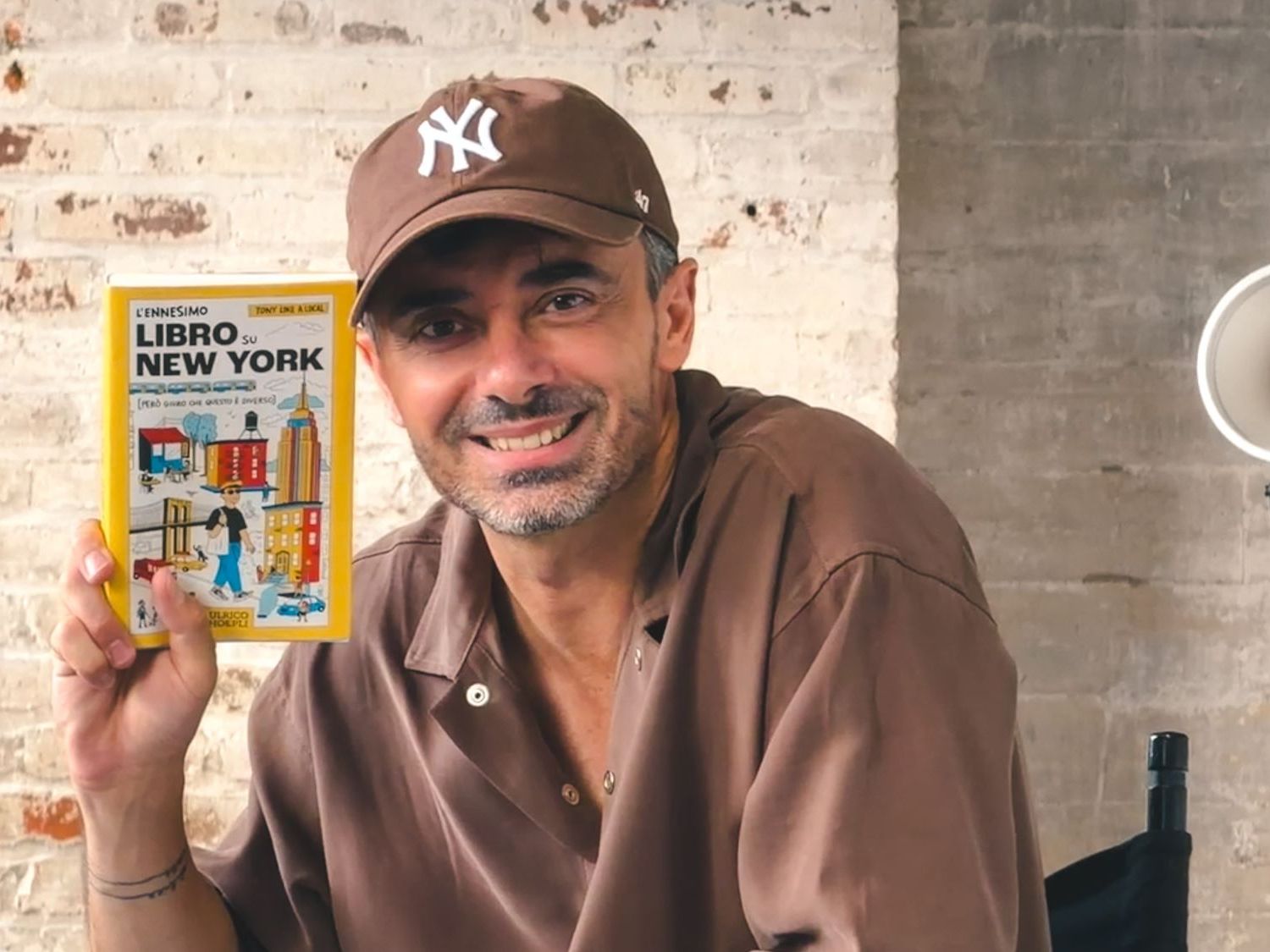
Tony Balbi, known on social media as Tony Like a Local, lives between Rome and New York and tells the city through its neighborhoods, locals and habits of those who live there. This work has become a book, The New Book on New York (but I swear this is different), published by Hoepli. The story develops around six themes – people, money, time, noise, smells and aesthetics – with which Tony tries to explain how you live a city that often has the impression of knowing even before you get there.
It happened to him in 2017, when he visited New York for the first time, at 34 years: the streets were the ones he had seen in the movies, but the everyday life of people was much more tied to the neighborhood than he imagined. From that discovery we started to talk about his book, how it makes sense to look for a “authentic” New York and how he changed his gaze on the city by visiting her with his daughter Alice.
In the book, tell you that you imagined New York as a child, but that you first arrived in 2017, at 34. What surprised you and what, instead, was just like you expected?
The first surprise came to dinner with my cousin, when he made me realize that they didn’t live in New York as in movies or television. We picture it with all those lights, the rooftops, that life a little bit in Manhattan. They, on the other hand, lived a lot more “to the village”, passed me the term: a neighborhood life, with small places of trust and spending always in the same place. A much smaller, almost microscopic dimension, compared to what we associate with such a large city.
What I expected, and that I found, was the feeling of recognizing the roads. I arrived with a mental map of the city, thinking: “I will recognize these things, because I have already seen them, I have already lived them.” And it really happened.
It’s a feeling that many people tell me, especially those who have long imagined New York: knowing what’s around the corner, recognizing a street, having the impression of knowing how to get to a place because you have seen it hundreds of times in cinema or television.
The two extremes are these: recognizing the places and discovering a way of living them completely different from what you expected. New Yorkers are not always running, always busy, always focused on work. They work a lot, it’s true, but when they come off, they come off.
It’s a difference that I know about Italians, I can’t say if it’s worth all Europeans. They distinguish a lot of work from leisure. We in the office are a little caciaroni, we make friends, and outside we keep thinking about the job and talking about it. Let’s make it harder to separate the two.
In the chapter «My New York City is not yours» you question the idea that there is a more authentic city of others. On social media, however, many promise to make discover the “true New York”. How do you choose places to tell without replacing the usual common places with others?
The first answer is personal taste. There are many viral places in New York: many are very touristy, others, while being famous on social, are also frequented by those in the city who live there. I don’t exclude a place because everyone’s already talked about it. If I think it’s worth it, I’ll talk about it too.
An example is the pizzeria L’Industria. It became famous also in Italy: the owner is Italian, I talked about it and many others talked about it. And yet there is a very local place. He sells cutting pizza, New York slice, and people line because it became popular. All the mechanism, from pizza to tail, is very New York. New Yorkers like to line up.
I don’t like the words “authentic” and “true”, because I think all New Yorks are authentic. Even a fast food chain that has become viral until Japan is part of the city and its imaginary. From a place with so many people you can expect this too.
The difference, for me, is between those who tell a local only because it is viral and those who spend time, frequents it and understands who goes there. Most of the places I talk about are not viral at all: they are locals frequented mainly by New Yorkers.
I often discovered them by almost randomly, because from outside I liked the lights. I have a passion for warm lights: just a counter with soft lighting and I feel like entering. Sometimes you find a place where you’re okay, you can spend some time with the people you love and those who run it can make you feel welcomed. New York is a very friendly city if you can take it.
You often describe New Yorkers as more direct in personal relationships and less conditioned by the judgment of others than Italians. Did something ever happen to you that made you see this impression?
In my experience, no, apart from some encounter with people in obvious difficulty. When I had different experiences, it was often about tourists or people who were not New Yorkers.
Going so often to New York has made me question, rather, the idea that we Italians are among the most kind and courteous peoples. We believe that we are, but we are not always prone to helping others. Sometimes we’re almost hostile to tourists.
I speak above all of the tourist cities, because the comparison with New York must be done with Venice, Florence, Rome. New York, for what I saw, you live well with tourists. I rarely had the impression that they were considered a nuisance.
I think there is a cultural component, but in my reading it also counts the economic well-being I have met. People complain about costs, high rents, and many of those I know are well. I think that also affects how to relate to others.
Of course, there may be an unpleasant encounter on the underground or on the street, with people who have economic or dependence problems. It happens to us, too. But I didn’t have an experience that changed my mind about the attitude of New Yorkers.
Why did you choose to build the book around six pillars instead of writing a traditional guide?
I always thought if I had written something about New York, it wouldn’t have been a guide to where to go. That I already do, at least in part, on Instagram.
Instagram, though, is volatile. A board that works today may no longer have value in two months. A book can be read after six months, a year or two: I wanted it to be as independent as possible from these changes.
I tried to locate the elements that, for me, make New York what it is, and I came to these six pillars. Above all, the first two columns and the last – people, money and aesthetics – seem fundamental to me to understand how the city moves, how it lives and how it changes.
I tried to translate New York into words and concepts. I also spoke to people who know her much more than me, because maybe they have lived there for twenty years, and they have recognized themselves in this reading. Someone would have added an element, someone else would have removed one, but the base was shared. I wanted to build a mental map of the city.
Two chapters are dedicated to noise and odor. What was the most difficult feeling to translate into words?
The smell of New York. The city has so many: urine, iron, metro, hot garbage. Taken individually, they are easy enough to imagine. If I talk to you about iron mixed with asphalt or urine on concrete, you can probably remember them even without ever being in New York.
The more difficult it is to tell what in the book I call “the smell of New York”. I try to describe it as a mixture of Fabulous, detergents used to clean roads, iron and cement, two very present materials in the city.
For me it is the first smell you feel when you leave the airport or enter the subway. He accompanies you as you walk and recognize it especially in the morning, after cleaning: he stays in the air and then mixes with everything else.
The smells of the different kitchens can also be told. Take them one at a time and then try to put them together, as ingredients in a pot. The underlying smell is more complicated: it comes from a combination of products and materials that is less familiar to us.
Your daughter Alice appears in the book. Looking at New York with her made you notice something that you missed earlier?
He made me discover that New York is a city for children. It is the opposite of what many think: such a big, noisy metropolis, with often narrow spaces, does not seem the ideal place.
Of course there is an economic question, and having a son in a big city, especially in New York, can be very expensive. After that obstacle, however, I see many favorable aspects: you are very outdoors, the parks are kept well and you live a lot in the neighborhood.
I’m thinking about moving. In Rome, to take a child to school, you can take half an hour, whether you go by bike, car or metro. In New York, in the reality that I have known, the school is often close to home and you get there on foot, maybe with ten minutes walk.
Obviously it depends on the area: in the farthest suburbs can be different. But in many parts of Brooklyn, Manhattan and Queens the proximity of schools changes daily life. Even when serving the school bus, in cases I observed the route it remains relatively short, a quarter of an hour or twenty minutes despite the stops.
Then there are playgrounds, playgrounds. They are kept well and fenced: for a parent it is reassuring to have a bounded space in which to let children play. Outside you can find the sign that says adults can enter only if accompanied by children. That’s a wonderful message.
I found a lot of attention in the premises, too. The high chairs are practically everywhere, not only in family restaurants. Often, as soon as you arrive, they give children something to draw or bring water into a glass with the lid. They’re small, but they help.
Have you noticed differences in the way parents organize the evenings?
Yes, and it’s another thing I’ve discovered standing there: in the evening children almost disappear, apart from those of tourists. In the habits of the New Yorkers I met, when you go to dinner, your children stay at home with the babysitter. From six onwards it becomes much more difficult to meet local families with children around.
I’m still deciding which habit I like most. Maybe the solution is in the middle. Sometimes we stress them by always bringing them out to dinner and making them stay up late. Even by limiting ourselves to the weekend, they get tired, they get nervous, and neither can we enjoy so much the evening.
Who is this book for?
It is a book for those in New York who have already been there and returned home with the feeling that something happened to him, but he cannot explain what. They asked him “how did it go? ” and answered “very beautiful”, knowing that it was not the right word.
For those who have to come back and want to prepare differently. Not with the itinerary, but prepare emotionally, not logistically.
And for those who have never been there, but he wants to understand why all those who have gone there continue to talk about it even months later.
It’s not for anyone looking for a guide. I don’t tell you where to eat or what to see. I’m talking about people, money, time, noise, smells and aesthetics, because New York understands itself through the dynamics that move in.
And then, in the end, it’s a book for those who have been following me for years on social media and always asked me the long version.
L’articolo Tony Like a Local wrote a book to live and discover New York <i>like a local/i> proviene da IlNewyorkese.