Simona Rodano has lived and worked in New York for twenty years, but the path that led her to take care of education, music and promotion of Italian culture began much earlier and in a completely different area. Biologist of formation, singer and actress, in 2006 she returned to the United States as an artist and since then built a project that put together theater, music and teaching of Italian to children. He founded Incanto Productions and, more recently, the Global Edu-Language Foundation, with the aim of giving continuity and a wider dimension to this work. In 2026, on the occasion of the 20th anniversary of the Italian Fairy, Rodano will bring for the first time to the United States a representation of the Little Choir of the Antonian, within the Generations of Voices project. In this interview he tells how his path was born, the relationship with New York, the work in schools and the network of institutions, foundations and communities that made the new project possible.
She has been in New York since 2006 and since then children have been a leading thread of her work. What is the budget of these twenty years?
Perhaps it can surprise to know that the first time I arrived in America in 1998 as a biologist. My way, then, seemed completely different: it led to the world of science and research. But within me I had always had a strong desire to become a singer. I used to sing as a child and have studied music. At one point a phone call came from Italy with the proposal to become vocalist in a television broadcast of RAI. I took one of the most difficult decisions of my life, because I loved the researcher work I was doing here in New York, but at the same time I loved the idea of being a singer. I then returned to Italy, worked fortunately on television and then went to the theatre.
In 2006 I returned to New York as a singer and artist, through an artistic visa. Initially I should have stayed three years, then the visa was renewed and my life changed again: I stayed in America. At that point, as an Italian, I began to wonder what I could do to find my way, what they call their purpose here. I started working for a company writing songs for children.
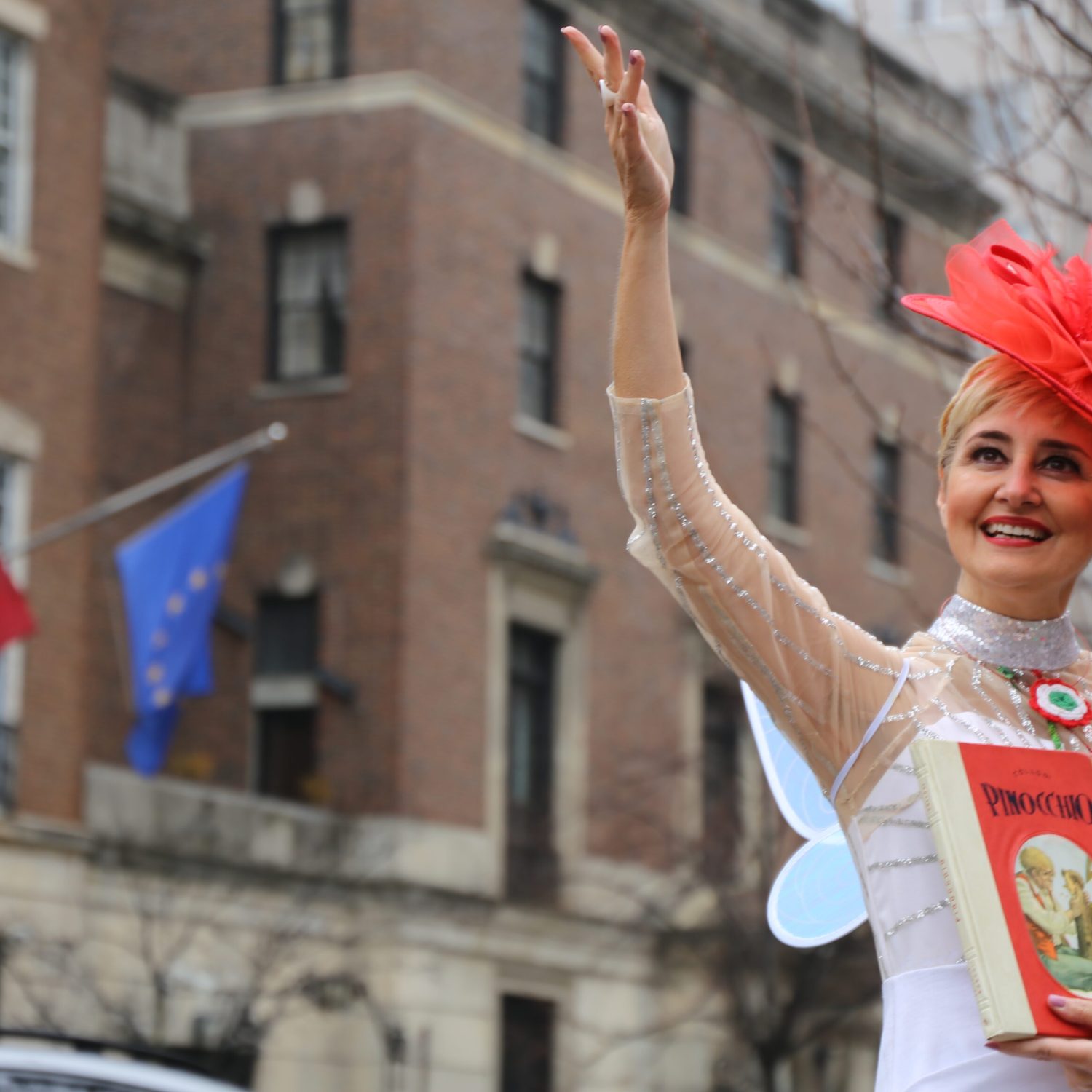
To write those songs, I went into the children’s classes. They didn’t know me, because I came above all to create, to develop a curriculum suitable for the little ones that allowed them to learn the Italian language. One day a father said to his son: “Look, there is fairy.” I looked around wondering who this fairy was, and then I realized she was talking about me. I went home, bought a couple wings and started filming myself and recording the songs. This is how the concept of the Italian Fairy in New York was born.
If there is a city where you can really explode with creativity and find many possibilities both as an artist and as an educator, that city is New York. From 2006 to today this has become my first mission: to promote Italian language and culture among children. At first I went privately to the houses, then I started contacting the first private and public schools and subsequently to perform shows for schools.
In 2008 I founded my first theatrical company, Incanto Productions, along with other artists who, like me, had come to New York with the desire to expand their creativity and to give a sense also to the fact of being Italian abroad. We were Italians with the heart full of dreams and we started bringing educational shows to schools. The project went on until today and now we work with a basin of at least 150 schools, in which during the year we propose projects of artistic nature”.
Here is very important what is called Arts in Education, that is to bring art into the world of education. Especially when it comes to learning a different language, in our case Italian, children and new generations learn much more willingly through art. It is a perfect channel, a fantastic means to make Italy and the Italian language love.
At one point it seemed that she should choose between being a biologist in New York or an artist in Italy. Instead, she managed to become an artist in New York.
It was not easy, even because I had to explain to my parents, who lived in Turin, that their daughter would return to Italy. They had imagined that I would end up working at some hospital or in a biologue research center. Feeling to say that instead I came back to work in RAI, in Milan, left them rather interdict. They were worried and they didn’t immediately understand that choice.
But I didn’t want to live with regret not trying. I had to try. At worst, I’d be back doing the biologue. I always had this second card in my pocket and this allowed me not to feel the pressure or fear of thinking: “If it doesn’t work, I ruin everything.” I think my pragmaticity has always helped me in life. I always thought there was a B option that wasn’t necessarily a discard option, but simply another possible way of life. Eventually, things went in the direction towards which my heart was taking.
After so many years of work he also created a foundation. How was the Global Edu-Language Foundation born?
I lived the foundation as a natural evolution of the work done in these twenty years. Also thanks to the encouragement of the Italian institutions, it is time to think about a legacy, something that could give a different and additional future than the proposals developed until then and the work done with schools.
Opening a foundation means giving a broader breath to the project, succeeding in building relationships and partnerships with many realities, especially here in America and especially with other not for profit organizations. It also means being able to sustain and sustain the educational project for the promotion of Italian language and culture, without relying solely on personal resources.
During the Covid, for example, it was very difficult to have a theatrical company and have to use its own economic resources to move forward. With a not for profit I immediately felt a great joy: the possibility to expand and evolve through partnerships with other organizations, with schools, Italy and America. It is a broader breath and above all the possibility of building a legacy that we hope will continue over time.
The foundation was founded in December 2024 and has as its first mission to promote Italian language and culture in schools. From this path also the connection with the celebration of the 20th anniversary of the Italian Fairy and the project of the Golden Zecchino was born.
It is a historical event: for the first time a representation of the Golden Zecchino will arrive in the United States. How did everything start?
About a year ago I was contacted by the Piccolo Coro dell’Antoniano. In the first contact we talked about the possibility to find a child or a child in New York who could participate in the edition of the Golden Zecchino in Italy. Of course, I immediately began to think about all the schools I knew and how feasible it was. It was possible: we could find a child or a child.
But the true mice was another. The Director of the Antonian, Fr. Giampaolo Cavalli, told me: “Simona, while casting children in New York, you may also think about proposing a song written by you for the Golden Zecchino.” I didn’t make it repeat twice. I spent a whole Sunday writing that song. At the moment I can not yet unveil the title, because of course we must respect the times of the Golden Zecchino, but for me that moment was very important.
The first challenge was to find for the first time a child or a child from New York who could sing at the Golden Zecchino, representing in some way the Italian-American community. The girl who was chosen speaks Italian, sings in Italian and is perfectly bilingual. The spark really started from there.
In the meantime, I knew the 20th anniversary of the Italian Fairy was coming and I wanted to celebrate this anniversary. One thing America has taught me so much is the importance of celebrating: celebrating work, finding a way to recognize what has been built. At one point, speaking with them, I discovered that they had been to China and many other parts of the world, but they had never been to America.
Inside me the desire to bring them here was born immediately. Because dreams are desires, but at that moment I also saw in front of my eyes the image of those children coming to New York and I thought I would want to be the one to give them this chance.
Sometimes a garden begins to sow from a small lot: then maybe trees grow and that land becomes a forest. I said, I can try. Can’t I bring sixty children? I’ll take less. I’ll take a representation, but I want to be the one to offer them this dream and this possibility.
Everything started from there. I launched myself saying: I will bring a representation of the Little Choir to celebrate and honor all the sacrifices and the work done in these twenty years. I called this initiative Generations of Voices, Generations of Voices, because through the foundation we would also like to succeed in giving continuity to the project and perhaps transform it into an annual review.
I imagine a review in which children, choirs of children and schools can meet and sing. She sings in Italian, but also in other languages, creating multiculturalism and an exchange between cultures that departs from children. This is the vision from which everything was born.
Have you ever been told she’s a visionary? Do you recognize yourself in this definition?
Absolutely. You hit the point: I have to see something in front of me, without a vision I can’t do anything.
For me vision is the dream, but it must be a calibrated dream. It cannot be a dream suspended by air, because if it stays too high it becomes difficult to carry it on earth. So with the staff of the Piccolo Coro dell’Antoniano, we designed an ad hoc project and this year they celebrate 67 years!
This experience also wants to be a sowing. To arrive with a group of children ready to connect relationships and create exchanges with the schools of New York, and then to the community. Because, beyond the initial vision, a project always develops through a teamwork.
The Italian community and the Italian-American community joined. Italian-American entrepreneurs have also mobilized. Starting from the school bus: for eight days the Piccolo Coro will travel to New York on the classic New York school bus and this idea makes them very happy. It means really bringing them into the culture of the city. As well as the children of New York go to school with the yellow bus, even the children of the Golden Zecchino will travel on the yellow bus.
Then there is the food and all the help we received from the Italian and Italian-American communities together. Children have this great gift: they can unite people, communities and cultures. The vision, at this point, has become really reality. I am no longer in the skin and I look forward to coming and can spend eight wonderful days here, between trips, concerts in schools and many other experiences.
The program will be very dense. Did you also expect moments when children can simply live and discover New York?
Yes, the program is very dense, but we will rightly try to leave some free time. Finally they are children and must have their moments to make a snack, have fun, walk and play. I think, for example, in Bryant Park and Battery Park.
We want to find a way to make them even an opportunity to discover New York and not just a continuous move from one concert to another. It’ll be beautiful. I’m really happy.
There will also be the Columbus Day Parade. She’s been in the parade for many years..
My first Columbus Day Parade was in 2010. That year we paraded with Pinocchio, the show I managed to bring here for the schools of New York. I came from the theatre and had worked in Italy with Pinocchio, so that represented the first great dream.
Everything started from there. We participated in the Columbus Day Parade, we made several shows and, from that year on, the Italian Fairy has paraded every year. Together with me there have always been school children and we have always performed a performance on the red carpet.
This year, however, that performance will have new protagonists.
This year I am very happy to be the children of the little choir of Antoniano to perform on the red carpet.
The Columbus Day Parade TV production machine is very big: it’s two very intensive hours on ABC, Channel 7, and all the artists and performances are organized very carefully. This year children will be protagonists of the performance on the red carpet.
It is a wonderful event and it was also one of the reasons that made me think it really made sense to bring here the children of the Golden Zecchino. Show them on ABC, take them to schools and organize concerts: a significant presence at Columbus Day Parade gives visibility to everyone.
A project of this size requires many collaborations. Who made this initiative possible?
Surely the Little Choir of the Antonian. Having a vision is important, but what really allows to accomplish things is to share it. In this case it was not enough that I had a vision: it was necessary that the Little Choir of the Antonian also shared it.
I found in them a huge availability and with them you work very well. We found ourselves immediately, because when there are children we must be moved also by values and philosophies of compatible life. We got stuck right away and everything started.
The mission of the Piccolo Coro dell’Antoniano has always struck me and captured me. I also know where my motivation comes from: it comes from my childhood. I grew up in Turin, attended the oratory. I am a girl from the oratory. When you grow up in that environment you share experiences that then, in life, can lead you to recognize yourself in certain values.
This is a cultural and humanitarian operation for me, with very strong values. It’s not a commercial operation, it’s something else. It is a humanitarian operation, one of those I believe needs.
Next to the Antonian there is the Italian Consulate. The Consul Pastorelli and the Director of the School Office, Daniele Castellani, immediately welcomed the initiative and understood the different messages.
There are also Italian-American organisations such as UNICO and UNICO Foundation, which supports the work of the Global Edu-Language Foundation. Here we go back to those synergies I was talking about when I explained why it was important to create a foundation.
There is also the Coccia Foundation, New Jersey. Thanks to them we will also take the Little Choir outside the State of New York: we will go to New Jersey for a concert aimed at the Italian-American community and more generally to the local community.
These are some of the main foundations. Then there are the Italian-American entrepreneurs who are helping us. In this project we have involved the Italian reality of New York at 360 degrees: the institutions, the Italian community and the Italian-American one. It was a great teamwork, started from last fall and arrived until today.
The initiative is promoted by the Global Edu-Language Foundation and by Incanto Productions. What role do the two realities play?
It’s always me, it’s Simona changing her hat. I started in 2008 with Incanto Productions, the theatrical company. Incanto Productions is the reality that realizes the contents: it is the engine and the executive arm.
When you have to bring children to the stage, organize performers, perform shows and take care of everything about content, Incanto Productions intervenes.
The foundation, on the other hand, represents the wider breath and the spread of the mission. Through the foundation we can organize events capable of generating fundraising and sustaining concretely and over time all the work we carry out.
L’articolo Simona Rodano: «In New York I turned a dream into a mission for children» comes from IlNewyorkese.