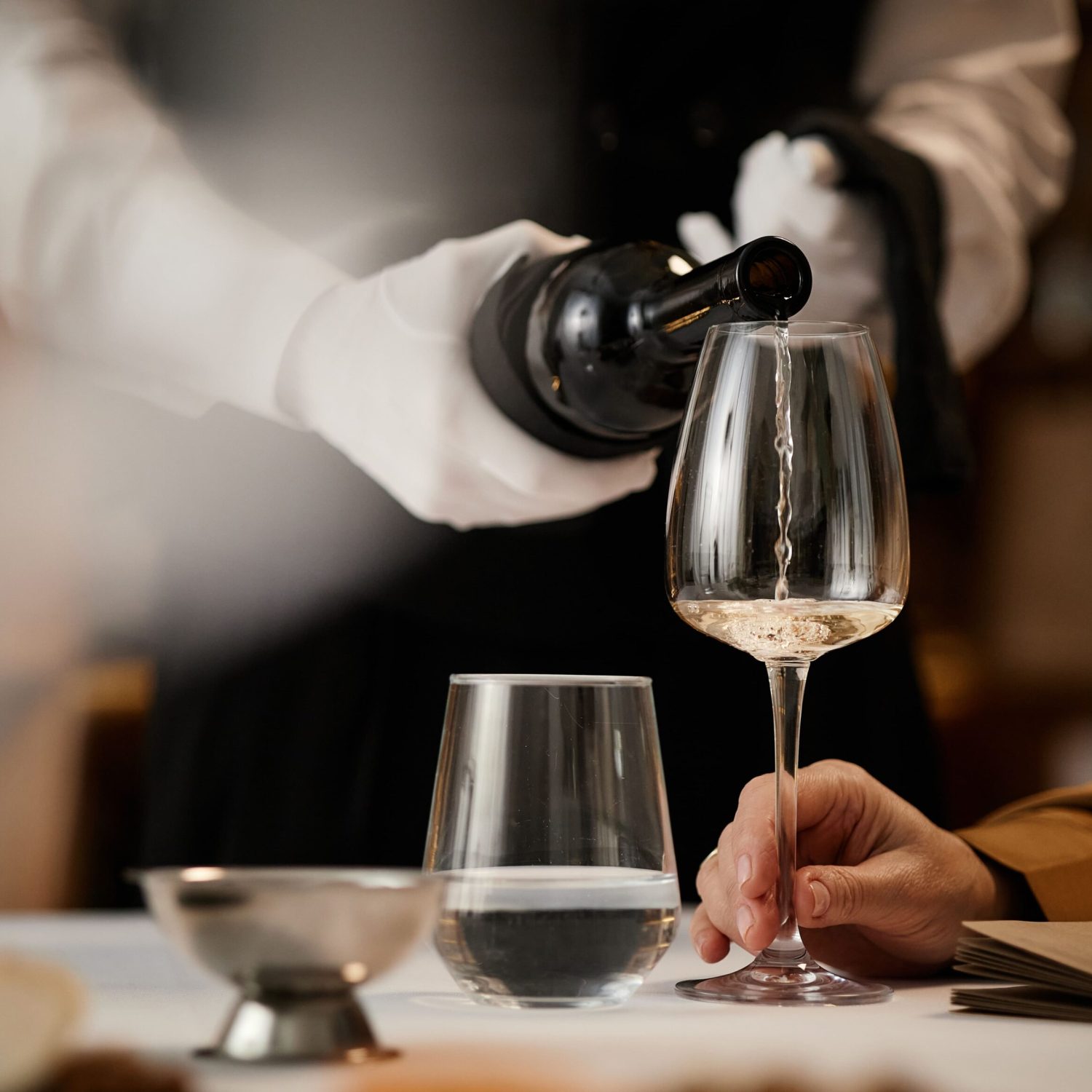
I happened, in a restaurant in New York, to sit at a table and note that the customers next to me, in front of a wine card forty pages long, instead of calling the room service, they preferred to question an AI sommelier on the phone typing: “I’m eating truffle pasta, we’re in four, I want to spend a maximum of $100 and I don’t love too structured wines. What do I order? ». A scene that, until a few years ago, seemed almost comic. Today much less.
Artificial intelligence is entering the world of wine not only to write descriptions, create images or translate technical cards. She’s starting to do something more interesting: recommend what to drink.
According to an American research conducted in 2025 by DRINKS and Dynata on 1,000 adult consumers, 31% of respondents had already used AI to help choose an alcoholic beverage. 71% were interested in using this technology if made available by online stores and retailers, while 76% felt that it would play a significant role in buying alcohol over the next five years.
But there is an even more significant figure: 44% of respondents would have entrusted themselves to AI to choose a bottle of wine or another alcoholic, while more than 40% would have followed it in a wine-food combination at the restaurant. In short, the digital sommelier is no longer a fantasy fiction novel, what we would once have entrusted to the books of Asimov, is slowly entering into everyday life.
A sommelier listens to what we say, observes what we eat, knows the paper and also interprets what we do not say. An algorithm does something different: it collects and crosses huge amounts of data. What we have purchased, how much we are willing to spend, the labels we choose most often, our preferences for acidity, tannins or body, the type of dish ordered and even the context in which we are drinking. You can understand why we like a wine by breaking that preference into measurable characteristics: acidity, tannic structure, aromatic intensity, body, alcohol, use of wood, fruity or spicy profile.
It is the transition from simple recommendation to taste profiling. And this is where AI becomes really interesting for wine. A bottle can be described, at least in part, as a set of data. Vitigno, region, vintage, alcohol, acidity, PH, tannins, residual sugars, etc. More information we collect, more sophisticated can become models.
Scientific research is going in this direction. A review published in 2026 in Comprehensive Reviews in Food Science and Food Safety describes the use of machine learning along the entire wine chain: from monitoring vineyards to precision viticulture, to fermentation control and wine making optimization. The researchers illustrate the integration of data from images, spectroscopy, chromatography and electronic sensors, combined through predictive models.
In other words, the future of wine could be much more “measurable” than we imagine, and not only in the glass. In the vineyard, artificial intelligence is already used to analyze plant images, identify disease signals, monitor maturation and support decisions related to irrigation, fertilization and crop management. In the cellar, the jump is even more fascinating.
A scientific review published at the end of 2025 proposes the concept of Intelligent Oenological System: a system that combines sensors, Internet of Things and AI models to monitor parameters such as temperature, pH, dissolved oxygen, spectral signals and gas development during the different stages of wine making. Predictive models could support fermentation control and decisions aimed at producing specific aromatic profiles.
The management seems clear: from experience to data, from data to forecast, from forecast to decision. But there is a problem, wine is not only a problem to solve. And this is where the paradox of personalization emerges. An algorithm could be extraordinarily good at choosing the wine we will like.
In a few seconds it could analyze thousands of labels, check which are available in that restaurant, compare prices and features, cross everything with our profile and propose three bottles. Precise, fast, customized. Maybe even too much. The more you know us, the more you risk to stop us from discovering something new. Customization could turn into an elegant form of homologation.
It is the same mechanism we already know through music, movies and social media: algorithms learn from our choices and return content ever closer to our previous behaviors.
In wine, however, there is something different. The discovery is part of the experience. A great sommelier should not only know what we like, but understand when we are ready to get out of our perimeter. He can offer us a vine we don’t know. A producer we’ve never heard of. A region we would never have looked for. A seemingly wrong combination that, once tried, works surprisingly well.
And above all, you can take the risk of wrong. The algorithm, however, is built to reduce error. The sommelier can say: “Page me.” The algorithm could answer: “According to your data, this is the most successful choice. ” They look like two forms of the same recommendation. I’m not.
The interesting thing is that, despite the enthusiasm, the American wine industry does not yet seem ready to completely delegate this task to machines. A research Wine Market Council/WineBusiness Monthly, conducted in 2024 on 266 operators in the sector and published in 2025, shows an adoption of the still very uneven AI.
39% of respondents used ChatGPT or similar tools for marketing, while 24% used it for translations. But when you switch from the company to the consumer, the numbers drop dramatically: only 8% used apps to help customers choose wine and just 4% claimed to use an AI sommelier application.
It’s important because it shows where we are today. AI entered the wine offices much faster than in the wine papers. The future must not necessarily be a restaurant without sommelier, with a chatbot instead of the professional. It could be a sommelier using AI as a second brain. A machine could analyze in a few seconds the inventory of the cellar, the prices, the available vintages, the composition of the dishes and even the preferences history of a customer.
The professional could use this information to do what a machine still struggles to do really: interpret a person. Because the customer is not always consistent with their algorithm. She can love Riesling and that night want a Nebbiolo. You can enter a restaurant stating that you don’t love natural wines and get excited about what the sommelier made him taste.
This unpredictability is not a system error. It is part of the human being. Perhaps, in a few years, the real luxury will be sitting in front of a forty-page wine card, not knowing what to choose and rely on someone who tells us: “Try this. ”
Not because that’s what our data has predicted. But because we never thought we’d choose it. Because wine, at the end, is not just what we like. It’s all we still don’t know we can love.
The article AI sommelier: Will the future of wine be an algorithm at the restaurant? It’s from IlNewyorkese.