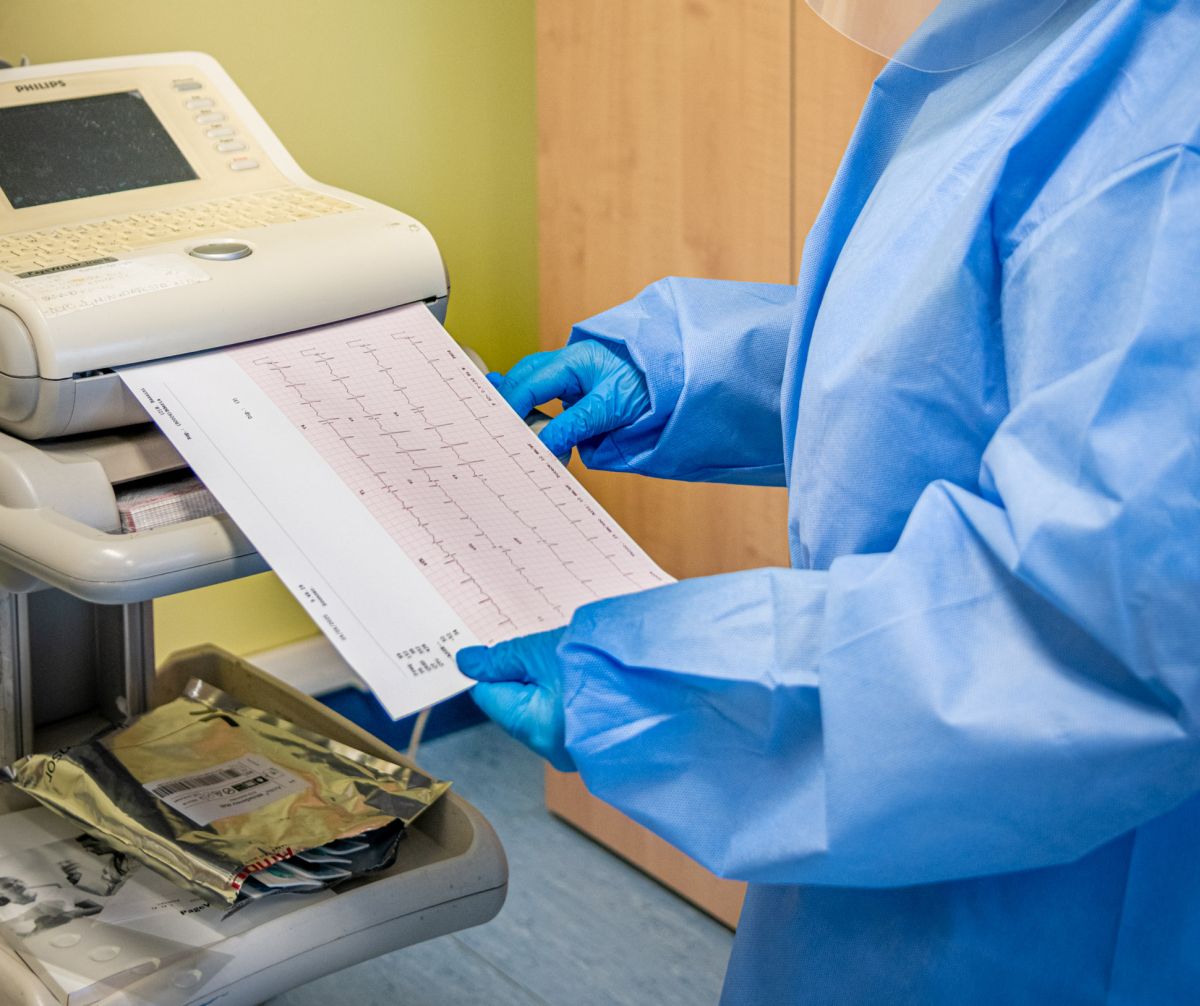
ROMA (ITALPRESS) – Diagnosing a principle of heart failure could soon require only electrocardiogram (ECG) a simple, fast and economical examination, without waiting for the time and cost of a blood sampling and an echocardiogram. This is the novelty emerging from an international Italian-led study, published in the prestigious European Heart Journal – Quality of Care and Clinical Outcomes. The researchers have developed a model of Artificial Intelligence (IA) able to read within a common electrocardiogram (ECG) traces invisible to the human eye, able to indicate with high precision if there is a high level of NT-proBNP, the reference biomarker for the diagnosis of heart failure.
In the study, which saw the collaboration of the University of Calabria, Humanitas University, the Federico II University of Naples, the University and the University Health Company of Trieste, the University of Zurich, Imperial College London, King’s College London and Seoul National University, researchers “trained” a deep neural network analyzing 84.895 electrocardiograms and NT-proBNP examinations. The algorithm has learned to seize electrical micro-signals imperceptible in traditional reading but related to the presence of the biomarker. Tested on 679 patients in Cosenza and Trieste centers, the algorithm showed an accuracy close to 90% in identifying risk values.
“The heart failure is one of the great health emergencies of our country – explains Ciro Indolfi, the first author of the study and president of the Fondazione Italiana Cuore e Circolazione della SIC -. In Italy it affects more than a million people, with an estimated 1-2% prevalence in the general population and about 80.000 new cases each year. The frequency grows rapidly with age and disease is among the main causes of recovery in the elderly, with a significant impact on mortality, quality of life, families and sustainability of the National Health Service.”.
Today the diagnosis of heart failure often begins with generic symptoms such as fatigue, fatigue or swelling in the legs. “To confirm the suspicion, we need a blood sampling with laboratory analysis (NT-proBNP dosage) and an ultrasound at the heart – says Gianfranco Sinagra, President of the Italian Society of Cardiology and co-author of the study –. However, the blood test requires adequate time, costs and structures, not always easily accessible on the territory or in smaller centers. The electrocardiogram, on the contrary, is an economic examination, not invasive, immediate and available everywhere: from the studies of family doctors to pharmacies, to ambulances. Applying AI to ECG allows you to transform it into a real ‘digital filter’: a tool that can immediately warn your doctor when it is really necessary to request laboratory and specialist insights.
The algorithm does not replace the laboratory biomarker and does not formulate alone the diagnosis of heart failure. Its possible clinical value is to promote a more early recognition of risk and a better selection of insights, especially when the blood test is not immediately available or is not required routinely. Even the use in opportunistic screening or, in the future, in population programmes is a perspective to be evaluated with dedicated perspective studies before a large scale spread.
“These results show that ECG contains more information than those visible to the human eye – Indolfi points out. With artificial intelligence, we can obtain for the first time from a simple and universal examination a warning signal on the possible increase of the NT-proBNP and direct the patient to appropriate investigations.”.
“It’s an approach – Sinagra continues – that can be particularly useful for the diagnosis and treatment of heart failure, especially in areas where access to the laboratory and specialist diagnostics is more difficult, helping to reduce territorial inequalities. Now we need prospective studies to demonstrate the effective benefit in welfare paths and clinical outcomes.”.
Cardiovascular diseases remain the first cause of death in Italy and are responsible for approximately 30% of deaths. The country has a national strategy for oncological diseases, but has not yet adopted a similar organic institutional plan for the prevention and treatment of cardiovascular diseases.
“The Italian Federation of Cardiology, with the support of the European Society of Cardiology, has developed a proposal of National Strategic Plan for Cardiovascular Health 2024-2027, which recalls the need to make more uniform access to prevention, early diagnosis and innovative therapies,” recalls Indolfi. “In this framework, preventing heart failure, recognizing it first and treating it according to evidence represents a strategic goal to reduce mortality, shelters, disability and costs – Sinagra points out. Artificial Intelligence applied to simple and already widespread tools, such as EG, can become one of the means for a cardiology of proximity and quality for citizens, regardless of where they live. Of course, for a clinical enhancement the data will then be placed in the overall context and there will be human intelligence and the competence of the doctor”.
– Photo Ipa Agency –
(ITALPRESS).