
ROMA (ITALPRESS) – Sometimes just add a few atoms to completely change the behavior of a molecule. This is demonstrated by a study published in Nature Communications, the result of the collaboration between the Officina Institute of Materials of the National Research Council (Cnr-Iom) and international partners.
Researchers have discovered why two small chemical changes make a ribozim, a particular RNA molecule capable of speeding up chemical reactions, up to fifteen times more efficient: a discovery that can help design more performing artificial ribozims, for example in biotechnology, as well as better understand the behavior of this RNA molecule in the early stages of life evolution.
Ribozymes are special molecules: unlike most RNAs, transporting or regulating genetic information, they are also able to speed up modification reactions of RNA bases, playing a role similar to that of enzymes. However, designing a ribozim from scratch is extremely complex and artificial ribozims obtained often show limited efficiency. For this reason, many studies are dedicated to understanding how to increase their activity and improve their performance.
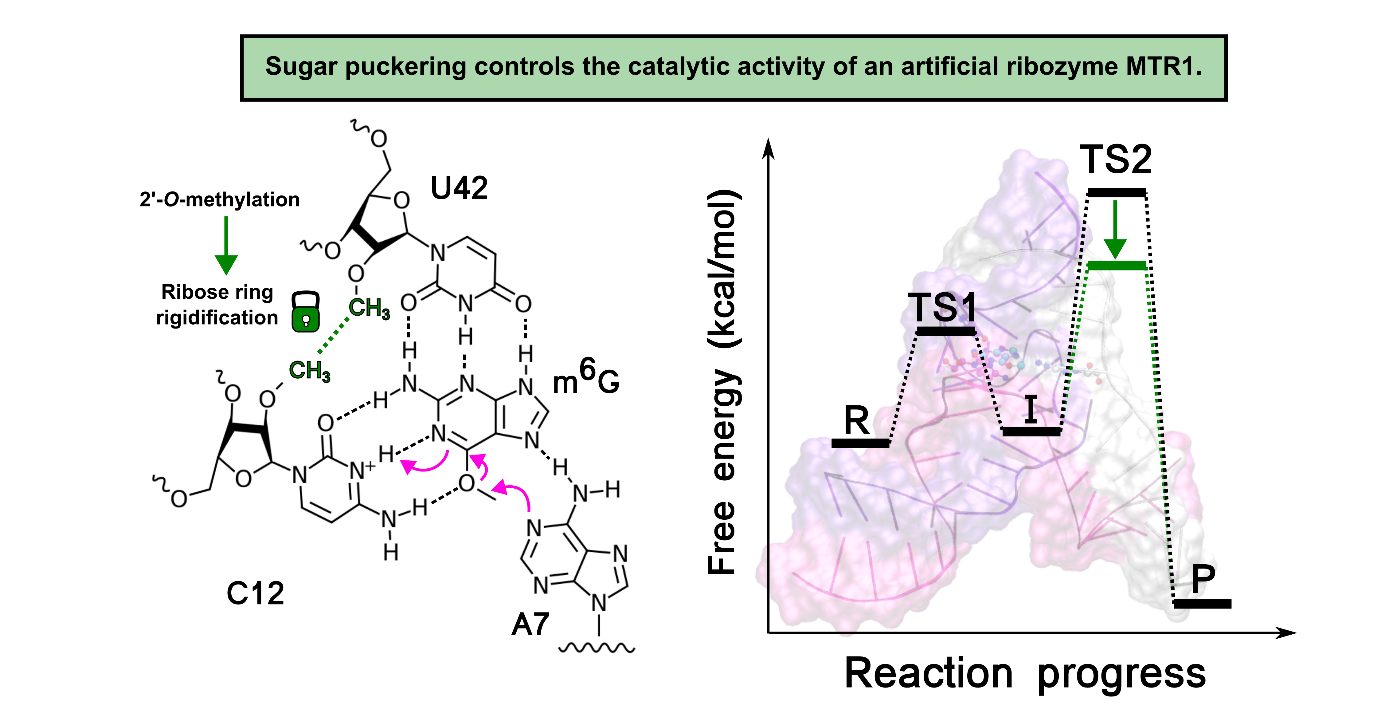
The research group studied a ribozim called MTR1, whose efficiency had been improved with the addition of two small methyl groups, in precise points of its structure. A methyl group is one of the smallest existing chemical units, consisting of only one carbon atom linked to three hydrogen atoms. Although it is formed by just four atoms, when added to the MTR1 ribozima, it deeply alters its biological activity. So far, however, it was unclear why these changes had such a marked effect.
“Our work shows that these chemical changes – which have the effect of drastically increasing ribozim activity – do not intervene directly in the chemical reaction: instead, they make the structure of the RNA more rigid, allowing the atoms involved in the catalysis to maintain the optimal layout. Understanding this mechanism gives us a concrete principle to design more efficient ribozimi”, explains Jana Aupic (Cnr-Iom), the first author of the study.
Thanks to computer simulations and the determination of the three-dimensional structure of the molecule, the team has, in fact, discovered at theomistic level that the two methyl groups make ribozim less flexible, keeping in the correct position the atoms involved in the reaction. In this way the reaction occurs more easily and more efficiently. Precisely having understood this mechanism could prepare the way for the design of new artificial ribozymes for the development of increasingly efficient catalysts, with possible future applications in biotechnology and RNA-based technologies.
“Not only: these knowledge will also help us to better understand the role that RNA might have played in the early stages of life evolution, as the results obtained also strengthen one of the most accredited assumptions about the origin of life, the so-called RNA world hypothesis,” adds Alessandra Magistrato (Cnr-Iom), who coordinated the research team.
According to this theory, before the development of proteins, RNA molecules played the role of catalysts in early biological reactions. Understanding how small chemical changes affect its activity also helps to reconstruct the possible mechanisms that have favored the evolution of the first forms of life on Earth.
The study is the result of close international collaboration with the research group led by Claudia Höbartner, of the University of Würzburg (Germany), for years engaged in the design and development of artificial ribozimi. The study was carried out thanks to a PNRR funding under the National Centre for the Development of Gene Therapy and Drugs with RNA Technology.
– Cnr press office photos –
(ITALPRESS).