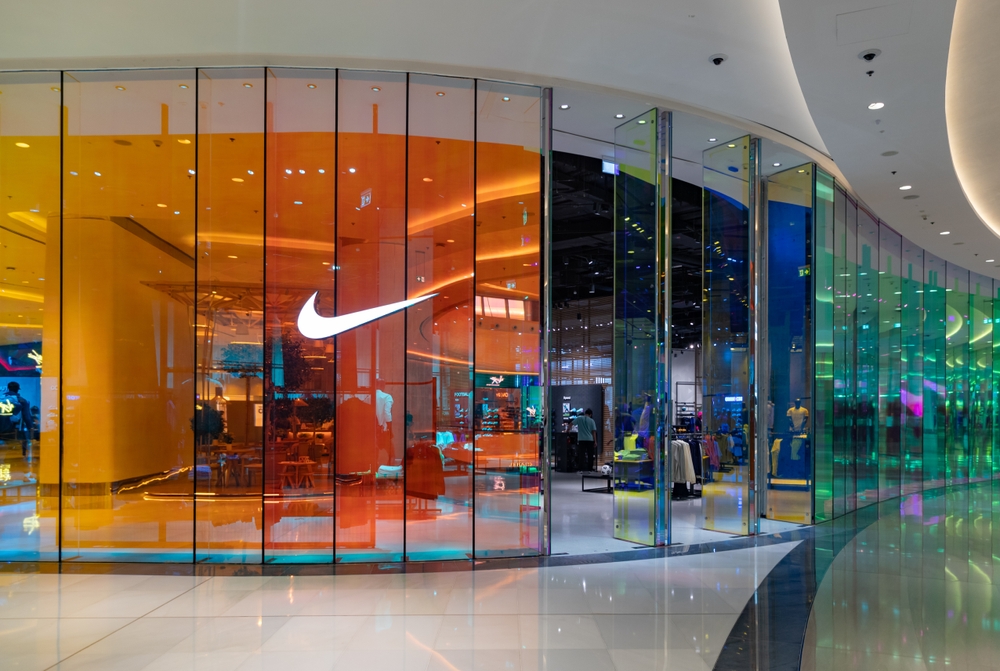
For many years, entering Foot Locker meant primarily choosing which Nike to buy. Air Force 1, Dunk and Jordan occupied the vast majority of the space on the walls dedicated to sneakers, while the competition divided the few remaining exhibition columns. That image, which perfectly photographed the dominant position of the company, in recent years has become much less common. On, Hoka, New Balance, Asics and Adidas have conquered space in stores and above all attention among consumers, while Nike navigates to the most complicated phase of its recent history.
The first signs had become difficult to ignore in the summer of 2024. In the fiscal year concluded on 31 May the revenues had grown only by 1 percent, up to 51.4 billion dollars, and in the last trimester they had decreased by 2 percent. Even more worrying was the company’s forecast, which expected a decline in sales in the following year. On June 28, the title Nike lost 20 percent in a single day, the worst result of its history in stock, erasing about $28 billion of capitalization.
The forecast was even optimistic. According to the results of the fiscal year 2025, revenues fell by 10 percent, to 46.3 billion dollars. Nike brand footwear sales decreased by 12 percent and Jordan Brand’s by 16. The decline affected both external stores and those controlled directly by the company, with a particularly strong contraction of the Nike e-commerce. The group remained enormously larger than the brands that were subtracting customers, but had stopped growing in a market where several competitors were doing exactly the opposite.
Part of the problem came from a decision a few years earlier. John Donahoe, who became CEO in 2020, had accelerated a strategy already started by Nike: selling a greater share of the products directly to consumers through the site, apps and shops of the group. In theory, it meant to retain greater margins and better control the relationship with customers. Nike reduced its presence to several retailers and cooled relationships built in decades with various chains, such as Foot Locker or Macy’s. However, when online sales stopped growing at the expected pace, recovering those reports proved much more complicated: on the shelves left free there were already other brands.
At the same time Nike had relied heavily on the products he already knew to sell. Air Force 1, Dunk and Jordan were proposed in many colors, reissues and collaborations, a profitable strategy until demand remained high. However, the increase in the offer ended in reducing part of the desire that those models had supported. In the results they began to appear more promotions and more products to be disposed of, while in the daily running it grew interest in shoes with much cushioning and geometries other than those to which consumers were accustomed. Nike continued to have technically very advanced products, especially in competitions, but could not transform with the same effectiveness that research into new models capable of imposing itself in the wider market. At the end of 2024 Elliott Hill, newly appointed CEO, said that the company had lost part of its “obsession for sport”.
Un esempio di modello di New Balance definito “chunky”
This is where Hoka and On have been included. Hoka has built much of his reputation on the thick soles and amortization, transforming an aesthetic that years before would have been associated almost exclusively with technical shoes in a product worn even out of the race. On followed a different path, building a more minimal and premium image around its CloudTec technology. They are even much smaller than Nike, but continue to grow faster: in the quarter ended in June 2026 Hoka’s sales increased by 7.7 percent, while On’s sales increased by 13.5 percent, and 21.6 percent to constant changes. Also On has recently begun to show some difficulties, especially in the United States, sign that the sneaker market in the meantime has become less simple for everyone.
Nike had begun to correct the strategy before Donahoe’s release, reducing Dunk’s offer, Air Force 1 and other popular models and allotting more resources for running. One of the leading products of this new phase was the Pegasus Premium, released in January 2025: it uses a large Air Zoom unit, ZoomX foam and ReactX and was presented as the version with the greatest energy return ever made in the Pegasus family. Together with the new Vomero and Structure it is part of a much more careful running line than the past, divided into models dedicated respectively to reactivity, cushioning and stability.
The change came with Hill, a manager who had already spent more than thirty years in the company before leaving it in 2020 and that Nike recalled in October 2024. One of his first moves was to rebuild relations with retailers. Hill directly contacted old and new retailers – Dick’s Sporting Goods, JD Sports –, recognising external stores a central role in distribution and also understanding what they want to buy customers. Meanwhile the internal organization has been redesigned around sports – running, basketball, football and others – instead of the previous division mainly between man, woman and child. Nike has called this strategy «Sport Offense».
Then there is an attempt to show that the company can still invent products that are difficult to replicate. In October 2025, Nike brought together innovation, design and product groups from Nike, Jordan and Converse and presented several experimental projects. The most unusual is Project Amplify, a racing shoe connected to a small motorized system that assists the movement of ankle and calf. It is still under development and will not solve the company’s accounts in the short term, but it says quite well where Nike wants to move the attention again: technology applied to sports instead of continuous variations of existing products.
The first results of the Hill cure, however, are contrasting. In the fiscal year ending in May 2026 Nike has turnovered 46.4 billion dollars, practically as the previous year; at constant changes the decline was 2 percent. In the last quarter sales through wholesalers increased by 4 percent, while Nike Direct fell by 7. It is one of the signs of the rebalancing of the distribution that the company is looking for. At the same time, very big problems remain: in Greater China (the geographical area that includes China, Taiwan, Hong Kong and Macau) quarterly sales decreased by 17 percent and Nike faces local brands, such as Anta and Li-Ning, as well as Western competitors. In the first months of 2026 new personnel cuts were also made: 775 places in U.S. distribution centres in January and around 1,400 places in April.
And even returning to the shops, alone, is not enough. The latest data from Dick’s Sporting Goods, which since 2025 controls Foot Locker, show that in the summer of 2026 most of the industry is dealing with too much inventory, discounts and less successful sneaker launches than expected. The old silhouettes that for years had guaranteed almost automatic sales work less well, while creating the next model able to become simultaneously a good sports shoe and a desirable object remains difficult for anyone.
It’s a pretty new situation for Nike. For decades he had had enough strength to establish himself what would end up on the walls of shops and, often, at the foot of people. Now you have to regain a space in the meantime become much more crowded. The advantage is that it still has resources, athletes, patents and recognisability that none of its younger competitors possess in the same measure. The problem is that the moustache on the shoe, after years in which it was almost enough alone, must return to having something new to sell.
L’articolo Once here was all Nike proviene da IlNewyorkese.