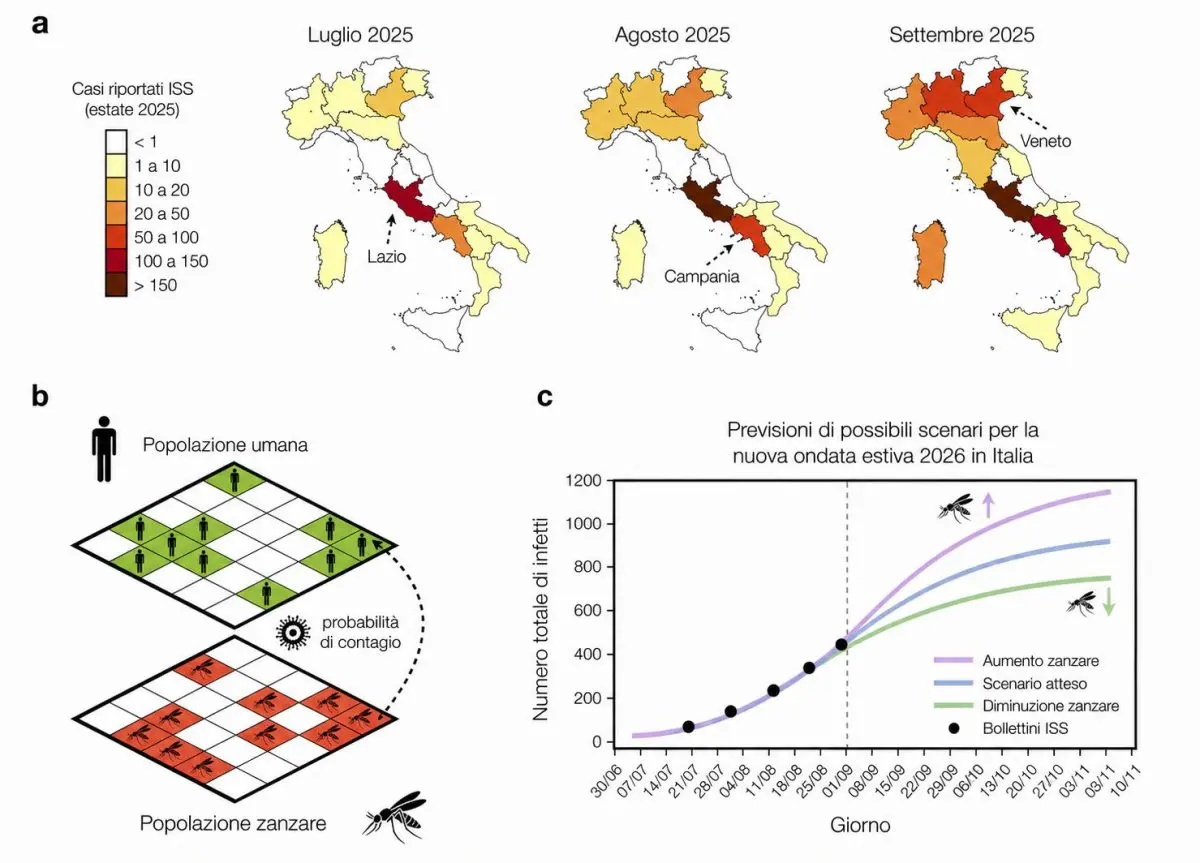
NAPOLI (ITALPRESS) – In recent weeks the West Nile virus (WNV) has returned to the center of attention also in Campania, where a death and some serious cases have recently been recorded in the provinces of Naples and Caserta. This is not a new phenomenon or a situation that must generate alarmism: for a few years the virus is now stably circulated in our country (a) and its diffusion is strongly linked to the presence of mosquitoes, which in turn depends on environmental and meteorological conditions, such as the increase in temperatures. Understanding how these factors can affect the trend of infections is therefore becoming increasingly important. To better understand how this virus spreads in the Italian regions, a group of Neapolitan physicists led by Andrea Maria Chiariello, professor of the Department of Physics “E. Pancini” of the University of Naples Federico II and an expert in Physics Theoretical applied to biological systems, has developed a new physical-mathematic model able to interpret the epidemiological data and indicate possible scenarios on the course of the waves of infection. Andrea Fontana and Simone Tambascia, co-authors of the work, explain that the model is based on two simple main ingredients: the human population and viral vectors, that is the common mosquitoes, which, moving in the system, interact with individuals and can cause new infections (b). The population evolves on the basis of a quantum version of the so-called Game of Life (i.e., game of life), a mathematical “game” developed in the early 1970s to study how simple local interactions can emerge complex collective behaviors and which, in this approach, is used to simulate the dynamics and mobility of the human population. In summary: when environmental conditions promote a greater presence of mosquitoes, also increase the opportunities through which the virus can reach man. It is precisely this step that the model tries to translate into quantitative terms. By comparing the results of the model with the data provided by the Istituto Superiore di Sanità (ISS), the group has shown that the method is able to reconstruct with great accuracy the waves observed in Italy in the previous years, like 2025, when a particularly high number of cases was recorded in Lazio, Campania and Veneto.
One of the most interesting results is the relationship with weather conditions. In fact, comparing the main epidemic waves of 2018, 2022 and 2025 with climate data, researchers observed that in the model the growth of the population of mosquitoes follows a trend compatible with the increase of summer temperatures and with the variations of relative humidity. The number of waves considered does not yet permit a definitive statistical correlation, but the result indicates a possible link between weather conditions, mosquito proliferation and infection spread. Once calibrated on real data, the model allows you to test different scenarios. It is possible, for example, to simulate what happens if the population of mosquitoes increases, as can happen following particularly favourable environmental conditions, or decreases due to control and disinfestation. The simulations show how variations in the presence of mosquitoes can significantly change the trend of the epidemic wave. The approach is also very flexible and can be extended to the study of other vector-borne infections, such as Dengue and Zika, mainly spread in Latin America and also studied by the Chiariello group with this method.
At the moment, the group is using the data of 2026 provided by the ISS to assess possible scenarios on the current season. Starting from the available data, the model reconstructs the initial phase of the spread of West Nile and simulates different evolutions according to the dynamics of the mosquito population, which can in turn suffer from weather parameters such as temperature and humidity. The goal, explains Prof. Chiariello, is to offer not only a quantitative description of the phenomenon, but above all a tool to interpret data, compare different scenarios and contribute to the evaluation of prevention strategies (c). The message is simple: no alarmism. Limiting, when possible, the conditions that favor the proliferation of mosquitoes can contribute to prevention, for example avoiding stagnations of water in the underwater and in the containers left outdoors. Also because, as simulations suggest, intervention on the presence of mosquitoes means acting directly on one of the elements that influence the possibility of spreading the virus.
– photo press office University of Naples Federico II –
(ITALPRESS).