
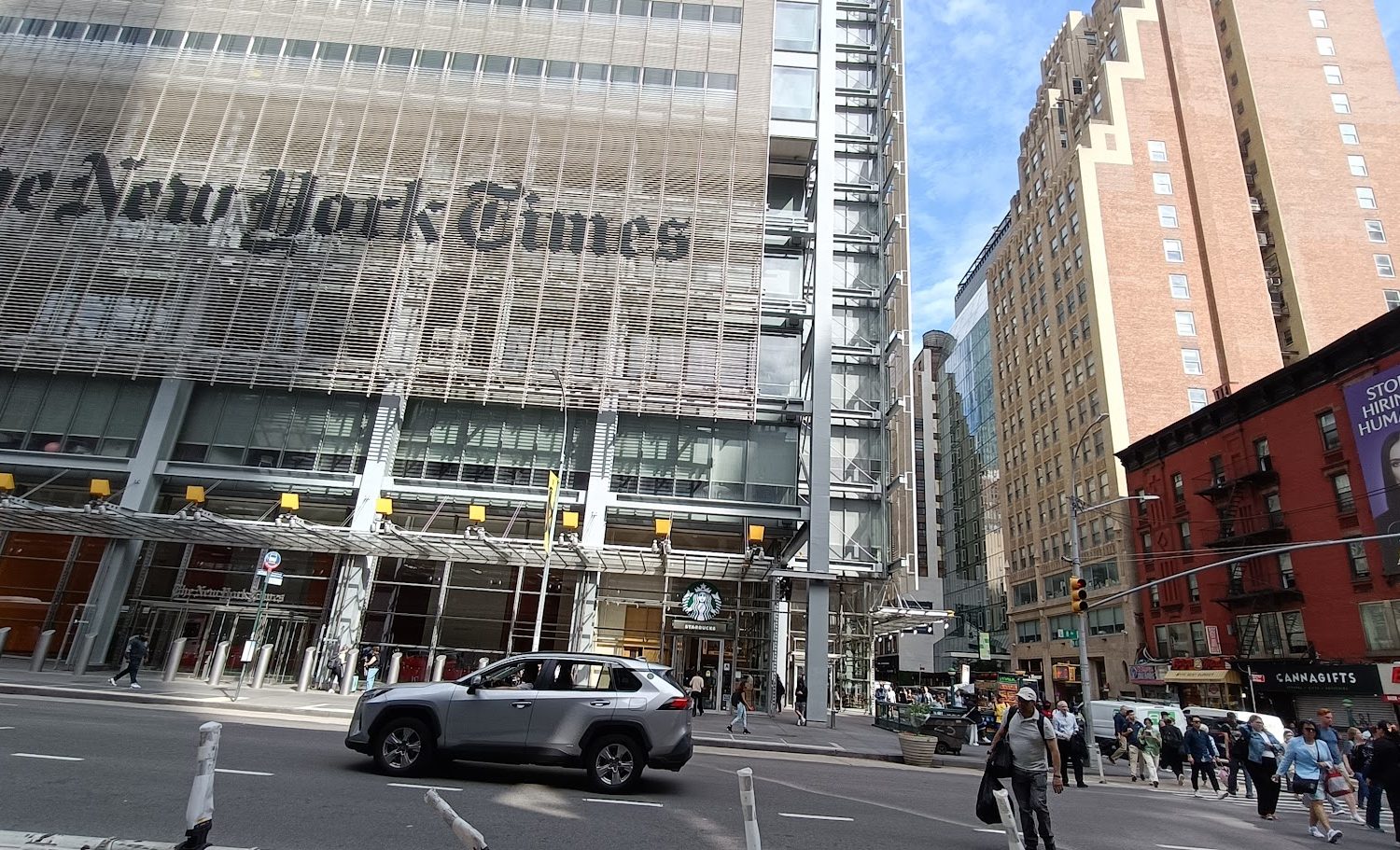
There is a photograph that, alone, strongly tells the historical crossroads of the journalist’s profession. The visual composition has the dramatic force of a theatrical scene: on the left stands the impressive glass and steel tower of the New York Times, a cathedral of global information where the lights of the desks never turn out, symbol of rigorous investigations, verified sources and soles consumed on the sidewalk; on the right, on the facade of the adjacent building, there is a huge sign of extraordinary advertising that celebrates the advent of Artificial Intelligence.
On the one hand the silicon of predictive models, on the other the flesh, blood and responsibility of the human intellect. It is the visual synthesis of an epochal transition, but above all the reminder of everything that technology can never buy.
No one denies that AI is turning journalistic work. It is a formidable tool for translating texts instantly, analyzing macroeconomic data bundles in a few seconds or opening hours of interviews. The algorithm promises to eliminate the friction of time. But the great journalism lives precisely in that clutch.
The advertising hangs next to the Eighth Avenue editorial team sells the great illusion of efficiency, the idea that a content can be born with a simple click. Yet an algorithm, by its very nature, cannot discover anything new: it reworks, chews and recomposes what the human mind has already entered into the network. IA lives in the past; journalism lives in the present and future.
When the comparison parameter is the excellence of investigation expressed by the New York Times, the claim to replace the reporter with the machine reveals its nature of mere commercial slogan.
There are three invariable boundaries separating a code from a great chronicler. The courage of responsibility: an algorithm does not risk prison to protect a secret source, nor does the moral and ethical responsibility of an investigation capable of shaking the palaces of power. The instinct of doubt: while AI seeks schemes and consistency in existing data, the racial journalist hunts anomaly, deburring, the stony detail that exposes the official version. The machine trusts the information you receive; the reporter is wary because they were provided. Empathy on the field: a prompt will never replace the look in the eyes of a witness in a war theatre, the perception of the non-dict, sweat and dust of the reportage lived in person.
How to sum up a maximum efficiency of the sector: “The Artificial Intelligence can write an article starting from a press release, but it will never write the article that that press release wanted to hide.”.
That snapshot with the two buildings flanked does not show a death sentence, but a forced coexistence. That advertising bill will remain there to remind us that mediocrity is no longer allowed: all that is lazy, bureaucratic and superficial will inevitably be automated. But as long as we need to reveal the truth, the lights on the facade of the New York Times will remain on.
L’articolo The shadow of the algorithm and the stone of the fact: because AI will never turn off the lights of the New York Times proviene da IlNewyorkese.