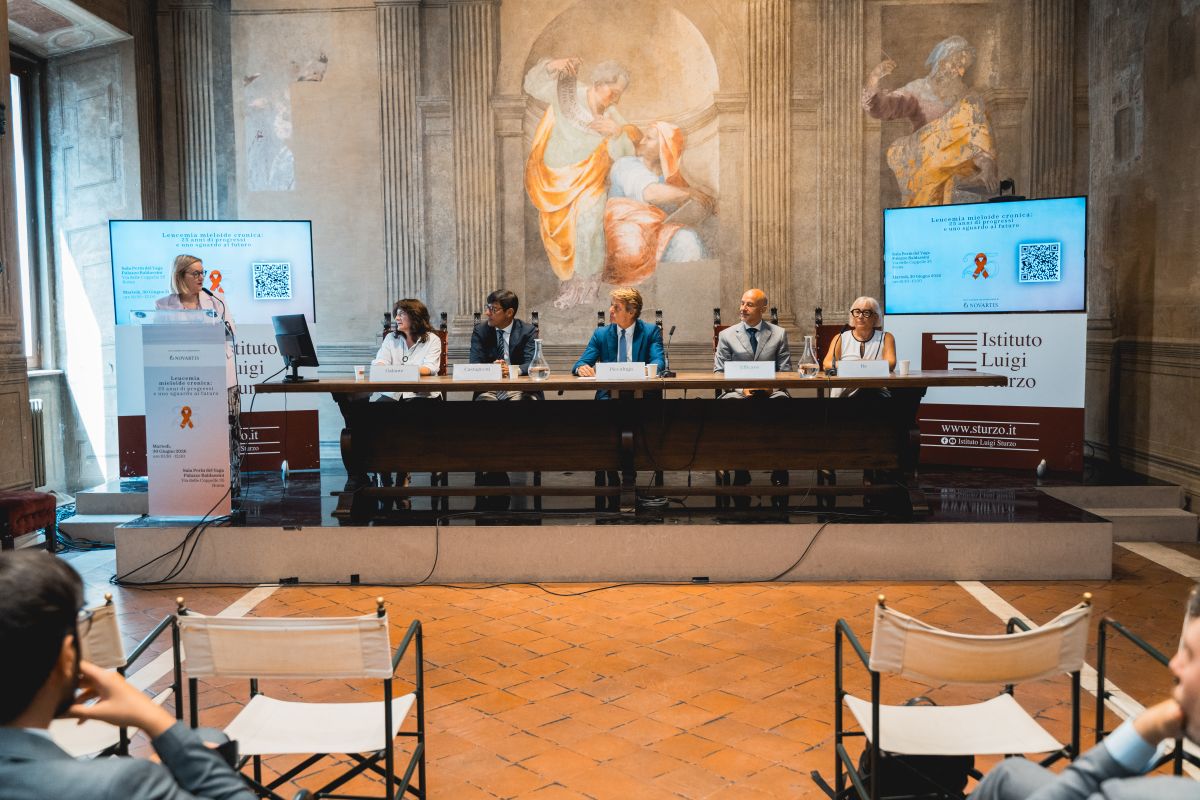
ROMA (ITALPRESS) – Today the press conference of the project “Cronic myeloid leukemia, 25 years of progress and a look at the future”, an initiative that brought together institutions, clinical experts and patient associations to deepen the clinical, welfare and organizational priorities related to the management of the Chronic Mieloid Leukemia. In the course of the meeting, realized with the non-conditional contribution of Novartis Italy, the Alliance Paper developed from a multistakeholder comparison path, with the aim of contributing to the definition of a shared framework of priority to enhance innovation and therapeutic effectiveness as levers to obtain deep and lasting responses, ensuring the continuity of treatment in chronic management of LMC. The introduction of thyrosin-chinasis inhibitors has altered the clinical course of pathology, allowing prolonged management and progressively shifting therapeutic goals from only survival to association with the tolerance of treatments, therefore to therapeutic adherence and quality of life. In this scenario, the attainment of deep and stable molecular responses, together with the possibility of accessing free remission from treatment in eligible patients, i.e. the suspension of therapy while maintaining pathology under control, is an advanced goal to reduce the continuous weight of therapy and reduce the impact of chronicity on the daily life of patients. The availability of effective and at the same time adequately tolerated options from the first line therefore assumes a central importance to support the therapeutic objectives over time, foster the continuity of treatment and reduce the therapy changes linked to unsuitable response or to problems of tolerance. In this perspective, Fausto Castagnetti, Associate Professor of Hematology of the University of Bologna, recalled the value of therapeutic continuity and monitoring over the long term, underlining that “The change of therapy represents today a concrete measure of needs still unsatisfied in the LMC. In many cases it does not only depend on an insufficient molecular response, but also on aspects related to quality of life and tolerance, which can affect the continuity of treatment. For this reason, the goal of achieving deep and stable responses must not be lost, until the suspension of therapy in eligible patients, through continuous follow-up and high quality molecular monitoring.” The comparison therefore highlighted the need to integrate therapeutic efficacy, quality of life and tolerability as central elements of the taking into account. Prolonged coexistence with LMC makes therapeutic sustainability central over time, especially when side effects, even if not severe, affect patient everyday life. The continuity of treatment, in this sense, affects not only the attainment of advanced clinical objectives, but also the possibility of reducing additional health access, shelters, work absences and impact on caregivers. In this perspective, the Alliance Paper presented highlights the importance of strengthening clinical-patient dialogue through structured listening tools and interoperable digital solutions, capable of making the patient’s experience more visible and supporting more consistent therapeutic decisions with the individual path. A need that is also reflected in the patient experience: Felice Bombaci, National Coordinator LMC AIL Patients Group, highlighted the concrete impact of therapy in the daily life of patients, stating that “When we talk about quality of life in the LMC, we need to look at the real life of patients. A side effect considered mild on the clinical plane may become a problem detectsfor those who work, they move every day and must maintain continuity in their activities. The same applies to access to therapies, which in many cases represents an additional burden in chronic management. The therapy should approach the patient, with simpler paths and more homogeneous models on the territory.” In the course of the initiative, the need to consolidate organizational models more suitable for chronic management of the LMC was also deepened. Increased survival and long-term care of patients generate increasing pressure on healthcare facilities and professionals, making it necessary to strengthen infrastructures, interoperability of systems and simplify processes. In this perspective, the organization of the load is an essential condition to make innovation truly accessible and to ensure continuity, appropriateness and quality of the path. “Cronicization of the LMC – says Fabrizio Pane, Professor of Ethology of the University of Naples Federico II – has generated an increasing pressure on organizational models, because patients are followed for many years and ambulancemen are increasingly crowded. To ensure excellent hematological assistance, clinical expertise, organisation and adequate infrastructure are needed. Italian hematology has high-level skills, but it is necessary to simplify processes, make systems interoperable and return time to clinical listening, so as to make it more sustainable. The comparison has therefore confirmed the importance of promoting a model of management of the LMC capable of connecting innovation, effectiveness, patient listening and welfare continuity. 25 years after the introduction of tyrosine inhibitors, a further breakthrough is needed, the challenge of the coming years will be to make the chronicity increasingly compatible with the daily life of patients, ensuring equal access to the most advanced therapeutic options and suitable for the individual profile, enhancing innovation as a strategic investment for the National Health Service. -photo press office Esperia Advocacy –(ITALPRESS).