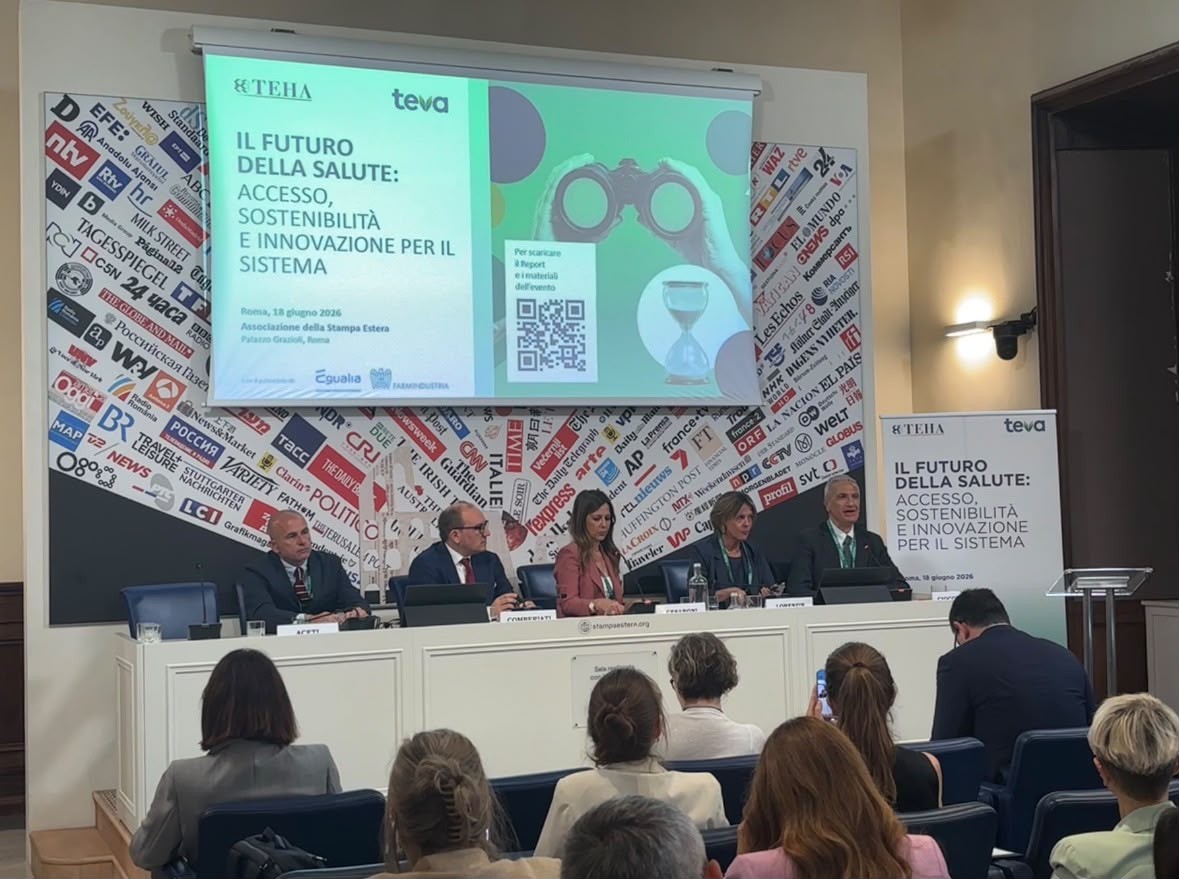
ROMA (ITALPRESS) – On the occasion of the thirty years of presence in Italy, Teva presented its contribution to sustainability in Rome, at the Foreign Press Office, at the event “The future of health: access, sustainability and innovation for the system” realized by The European House – Ambrosetti (TEHA). The history of Teva in Italy began in 1996, at a stage in which the national market of equivalent drugs moved the first steps. In 2025, Teva distributed more than 101 million packs of drugs in the retail channel and touched the 150 million units in the hospital channel. Overall, between 2022 and 2025, volumes exceeded 400 million retail packaging and 552 million units in the hospital channel respectively. The company therefore daily accompanies patients and health professionals in pharmacy and hospital throughout the treatment path, considering that almost 1 equivalent drug on 4 distributed in Italy is a Teva product. In 2025 the equivalent drugs of Teva allowed the National Health Service an estimated savings of 350 million euros. Value exceeding 1.16 billion euros in the period 2022-2025. “Three years of presence in Italy give us a clear responsibility: to continuously contribute to the sustainability and evolution of the National Health Service, ensuring access to care, quality and therapeutic continuity for millions of people. Today the equivalent drugs are not only an instrument of efficiency: they are a structural component of the health system, able to support the management of chronicities, reduce the barriers of access and free resources to reinvest in innovation and services” commented Umberto Comberiati, CEO and President of Teva Italia. The value of the equivalents is particularly important in the light of the demographic and epidemiological changes in the country. In Italy, 13 million people live today with at least two chronic diseases, 30% more than in 1993. Pathologies that require continuous management, often for many years, and for which economic accessibility, adherence and therapeutic continuity represent fundamental components of the treatment path. “The Italian health system is going through a structural transformation: the ageing of the population, the growth of chronic diseases and the emergence of more complex needs make the ability to combine access to therapeutic care and innovation increasingly central. In this scenario, the presence of operators able to guarantee both widespread availability of essential therapies and development of solutions in areas of high clinical need is a strategic lever for the sustainability and evolution of the National Health Service”, said Daniela Bianco, Partner and Head of Practice Health & Life Sciences of The European House – Ambrosetti. Accessibility also covers families directly. The price differential between expired patented ex-originator drugs (commonly called “branded”) and equivalents determines an additional expense to the citizens estimated at approximately 1.1 billion euros each year. A fact that is even more important if read in the European comparison: Italy remains among the countries with the lower penetration of the equivalent drugs, which represent 9% of the total pharmaceutical market in value, in front of 54% of the UK and 30% of France. Reducing this avoidable expense means removing one of the obstacles that can affect the continuity of care, especially for chronic patients, people with lower economic availability and those following complex therapies. In addition to its role in ensuring the availability of accessible therapies, Teva has progressively strengthened its commitment to research and innovation, concentrating it in therapeutic areas characterized by clin needsici and social still partially dissatisfied. In the period 2022-2025, investments made in Italy in research, development and clinical research amounted to 3 million euros. Teva’s research focuses in particular on neuroscience and immunology, with programs that affect pathologies such as migraine, schizophrenia, multi-system atrophy, asthma, vitiligo, chronic intestinal and celiac inflammatory diseases. Among these, a central role is occupied by Brain Health, one of the major emerging challenges for health systems: neurological and psychiatric conditions affect for more than 18% of overall health loss globally and, only in Europe, concern about 180 million people. The experience of Teva in migraine is a concrete example of this approach. Teva has built over time a plan consisting of 35 studies, including recording, intervention, observational and real-world studies, from which over 105 scientific publications are derived. Italy has played a significant role in this plan, with five multicentric studies that have involved Italian structures and which have contributed to the realization of ten scientific publications, linking the international research of the company with the national clinical community. “In these 30 years we have developed a consolidated ability to innovate in neurosciences, more recently flanked by the extension of our pipeline in the immunological field,” continues Teva CEO Umberto Comberiati. “The pipeline reflects this evolutionary path: not only development of new therapies, but a structural commitment to transform emerging needs into concrete solutions for patients. For us access and innovation are not alternative dimensions, but two complementary levers through which to contribute sustainablely to the evolution of the health system”. -photo press office Teva –
(ITALPRESS).