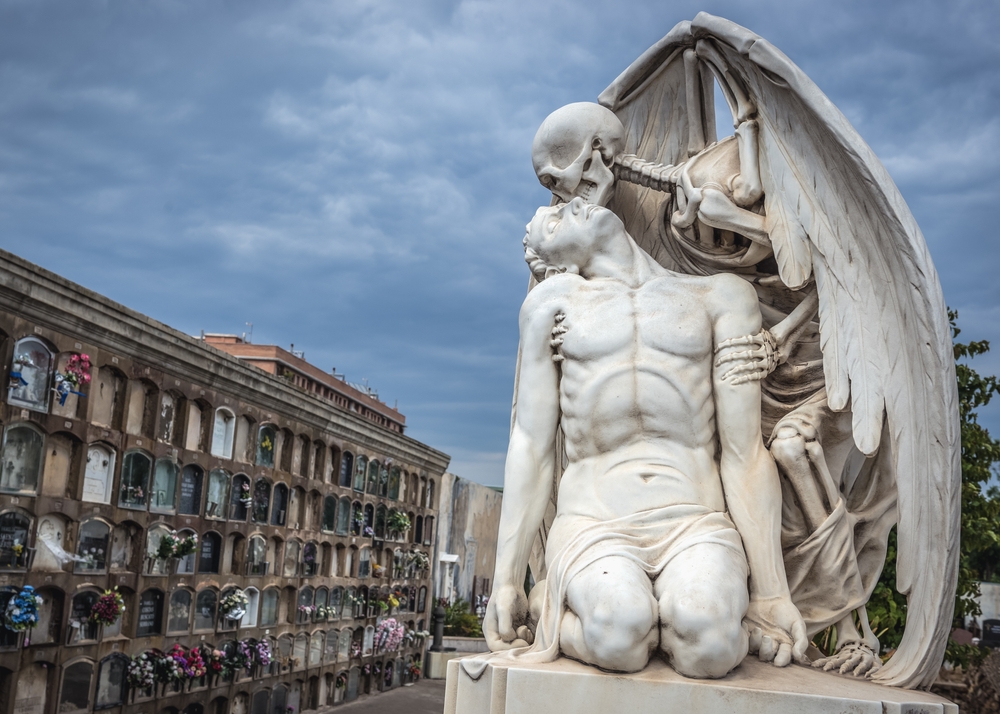
I’m talking about death while I’m alive and this is already a countersenso. Who established that death should be thought only when it happens? Who decided that it should be feared, “evitated”, kept far until the last moment?
We human beings live immersed in life, yet we continually build images of death. But these images are not born of a real experience: they are born of society. Death is taught us as something dark, cold, fearful. In movies it’s dark, it’s fine, it’s loss. But then the question changes direction: are we really fearing death, or the idea that we were taught about death?
The human being is dependent on sight. Let’s see how to guide us, see how to recognize us, see how to exist. Our reality is built on what appears. But then what happens when all this disappears? When we die, we won’t see, and if we don’t see anymore, what’s left? Are we still something? Or is the limit not death, but the fact that we are not able to imagine an existence without perception?
Maybe we’re not afraid of death. Maybe we’re afraid to lose our only way of understanding the world.
Death is not announced; it happens. Today we are here, tomorrow we may not be there and this possibility, so simple, is unbearable. Because it breaks every illusion of stability. The body feels it: a burning in the chest, a sudden tension, the desire to scream without knowing what to say. It is not only a thought, it is a physical reaction to the impossibility of controlling. Death is the only event we cannot predict, neither postpone, nor manage, and this frightens us. Not because he’s dead. But because it’s out of every human pattern.
The fear of death is not universal. It’s culture. There are societies that do not live like us, which do not turn it into terror. This means that fear does not spring from death itself, but from the way we learn to think it. We live in a system built on artificial concepts: growth, success, money, progress, technology. All elements that in nature do not exist. Yet they become fundamental. Death then appears as a threat, because it interrupts all this. But if what is interrupted is built, then also fear for such a natural thing is built. We do not fear the end of life, but we fear the end of what has been taught us to consider indispensable
Inside each individual there are two tensions. A part pushes towards self-building: it wants to become “someone”, wants to grow, wants to affirm itself. But this “some” does not arise spontaneously, is the result of social expectations, models, external demands. It is a trajectory already traced. And then there’s another level. A quieter, deeper part that looks. That he stops questioning all this. That recognizes how many of the structures on which our lives are based do not have their own existence: technology, money, social organization, the concept of growth itself. They’re human constructions. And then a fracture emerges, because at the time of death all this remains: if tomorrow a catastrophe happens, everything we consider necessary today would disappear and the world would return to a original condition. Like millions of years ago. Nature wouldn’t lose anything, we’ll just lose what we invented.
Perhaps the problem is not death but the look with which we observe it. We judge it through human categories, but death is not a human concept. It is a natural concept and nature does not need to explain itself. We do. We need to see, understand, give a name to everything. And when something escapes this need. They call her fear. But fear is not born from death. It comes from the limit. Since, for the first time, we are faced with something that we cannot control, that we cannot imagine, that we cannot see. And then they fill it with darkness, silence, end. But maybe it’s nothing. Perhaps death is not absence, it is simply absence of what we know and this is enough to scare us. But if for a moment we came out of ourselves, from our categories, from our constructions, then it would change everything. Because death is not the opposite of life, it is the opposite of our ability to understand it. And maybe that’s why it’s not something that needs to be solved. It is not a problem, it is not an enigma, it is only the point where man stops being measured of all things.
And then there is no fear. Just something we never learned to look at.
L’articolo The unawareness of the afterlife proviene da IlNewyorkese.