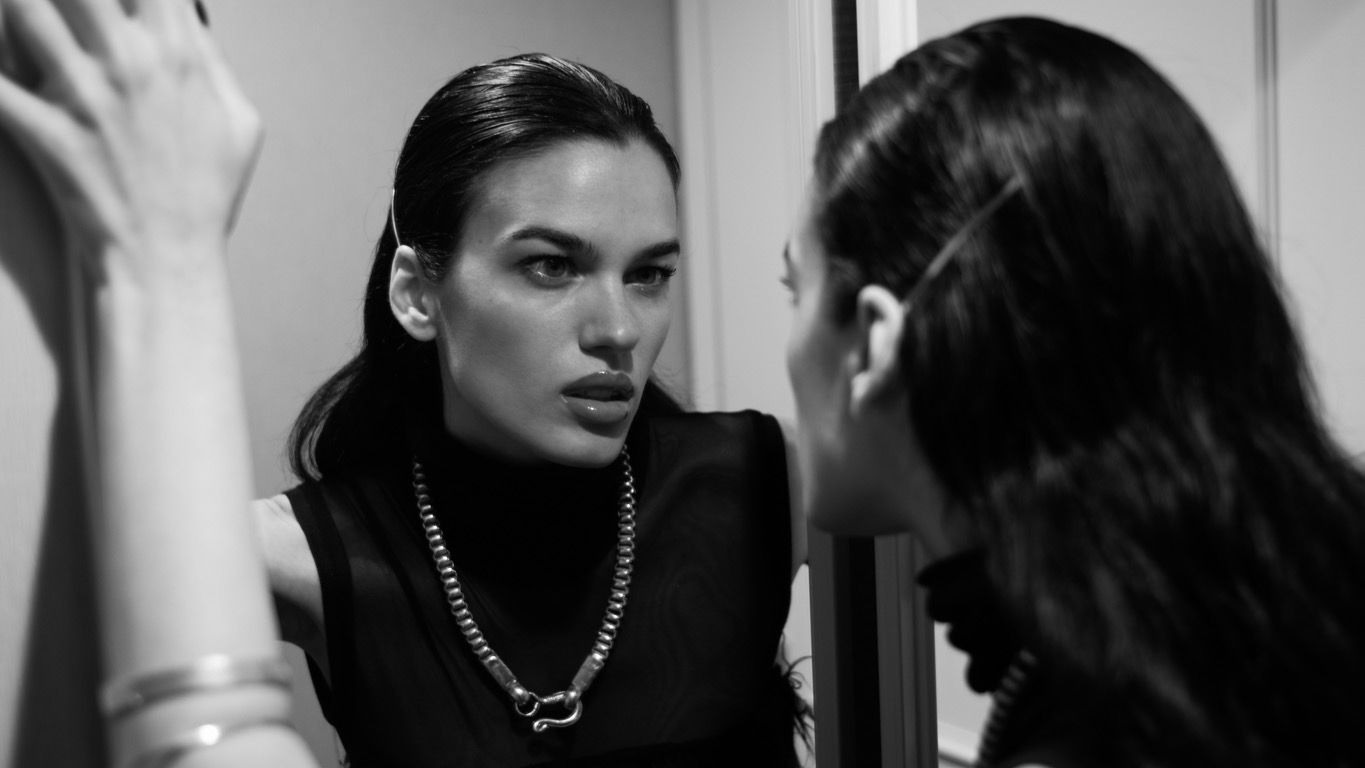
Elena Azzaro is an Italian model of Sicilian origins, today based in New York. He works between the United States and Europe and built his way through editorial shoots, advertising campaigns and parades, collaborating with several brands, including Vivienne Westwood and Armani. Its presence is defined by a classic but decisive image and a great versatility in front of the camera. With Italian roots and growing international visibility, it represents a new generation of Italian models that are building their career in global fashion markets.
Your work moves between image and interpretation: how much of what we see really represents you and how much is it built specifically for the camera?
My work always involves building a character. Every time there is a story to tell and a brand to represent, so I have to play a role. It’s a bit like silent acting. Sometimes the character reflects my personality, sometimes not, but that’s exactly what I like: being able to enter different roles.
Fashion often changes very quickly, while identity remains more stable. How can you keep your identity in an industry based on continuous reinvention?
That’s a very interesting question. We models are a bit like canvases on which customers project their vision. That is why we are often asked to be neutral. But with time, you develop a personal style, and that’s what really makes you stand out. Even if the system tends to match you, then authenticity always wins.
There is a difference between being seen and being remembered. What does an image remain in people’s mind?
An image remains when it provokes a positive or negative emotion. It is the result of many elements: light, expression, atmosphere… as in a picture. If you’re handling something, then it’s a good photograph.
Is there an image of your career that you are particularly linked to?
I don’t have one. There have been many important shootings, each for different reasons. It is difficult to choose only one.
Do you remember your first Fashion Week?
Yes, I had a heart a thousand. I thought with time that feeling would disappear, but it’s still there. And that’s what makes you feel alive.
Have you worked with very different aesthetics and narratives: have you ever felt badly represented or misunderstood in a project?
No, it’s usually very clear: there’s a moodboard and there are precise directions. Part of our work is to adapt to the project. I’ve always worked in respectful environments. But it is important to say that if something makes you uncomfortable, you have to talk about it. It’s not always enough, but it’s essential to know when to say no.
In fashion, beauty is often defined by external standards. Have you found a personal definition of beauty or is it something that keeps changing?
It is something that continues to evolve. I personally find perfection in imperfection. In this area you can see many types of beauty, but it is often the imperfections to make a person interesting and unique. Even what you consider a defect can become your strength. Homologation exists, but in the end what really emerges is to be oneself.
What are you doing on the set and nobody taught you?
The way I move and pose. I studied classical dance for many years and this gave me body awareness and fluidity. It is something that comes naturally to me and is difficult to teach.
Being Italian brings with it a strong cultural identity: has it influenced your way of working or how you are perceived abroad?
Yes, especially abroad is seen as a value. In the United States, for example, Italians are very appreciated. In the past, however, Italian models were sometimes set aside in Italy. Luckily this has changed.
The work of the model is often underestimated. What would you like to clarify?
That is not just “be beautiful”. It is a work that requires technique, physical and mental resistance, continuous travel, many hours of work and ability to adapt. Then there are relationships and management of your image on social media: it is really a 360-degree job.
Do you think the fashion industry is really changing in terms of inclusivity?
Compared to 10 or 15 years ago, yes, it is more inclusive. But on the catwalks there is still a lot to do, especially regarding the sizes. In the editorial shoots you can see more varieties, on the catwalks much less, especially in Europe.
What is the least visible part of your work?
Everything that happens behind the scenes: agencies, casting, management. And then uncertainty: you never know when you work. It’s not a stable job like others.
How much does discipline count in this work?
It is absolutely essential. You need to take care of yourself: nutrition, training, energy, and so much mental strength. Security itself is also very important. It’s not as simple as it sounds.
Have you ever had particularly difficult times in your career, so you can question everything?
Not really, but being discarded in some castings that I cared for was very difficult. But I never questioned myself or my passion. I always kept believing in my work, my goals and myself.
What advice would you give to those who want to start working in fashion?
Not to start too early: better from 18 years on. Ask yourself, talk to other models and pay attention to agencies. It is a beautiful job, but also very challenging.
Do you have any new goals or plans for the future?
Yes, I’m working on new projects related to food and cinema, between Italy and the United States. I can’t say too much for now, because I’m still under development, but there will be so much news.
L’articolo Elena Azzaro: “You know when to say no” comes from IlNewyorkese.