ROMA (ITALPRESS) – From the therapies that slow Alzheimer and Parkinson to drug-conjugated antibodies in oncology. From artificial intelligence that lowers the access barriers to clinical trials to the surgeon “enhanced” by artificial vision. These are some of the themes that will be addressed during the Clinical Trials Day conference, a two-day sponsored by Fondazione Policlinico Universitario Agostino Gemelli IRCCS, Università Cattolica del Sacro Cuore and Ospedale Isola Tiberina-Gemelli Isola, scheduled on 20 and 21 May 2026 in the Auditorium of the Roman seat of the Catholic University (Largo Francesco Vito 1).
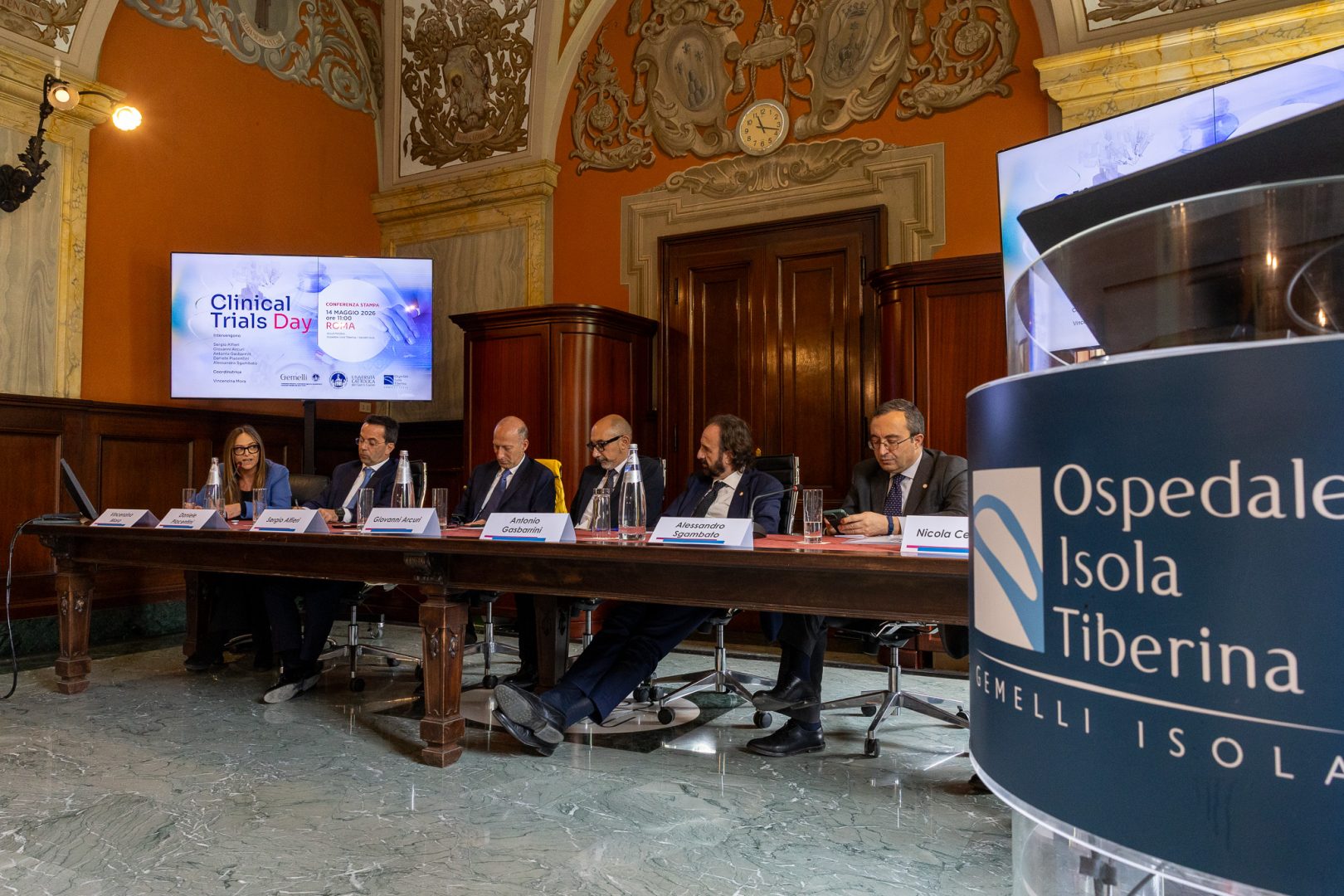
The presentation of the themes took place today, with a press conference organized in the Aula Magna of the Hospital Isola Tiberina-Gemelli Isola. For diseases like Alzheimer and Parkinson the scenario in recent years has been overturned: research today focuses on neuroinflammation, biological mechanisms at the base of neurodegeneration and molecules that affect anomalous protein, such as beta-myloid and tau, or modulate the brain immune system before the damage becomes irreversible. Slowing the progression means returning years of motor and cognitive autonomy. However, new disease-modifying drugs require extremely precocious diagnosis and toxicity profiles (microemorrhages, brain edemas) that require stringent monitoring. The hopes are now on studies concerning blood biomarkers, capable of diagnosing disease years before symptoms, and combined therapies. Ovarian and prostatic carcinoma live a parallel revolution: in the ovarian, they explode the ADC (Antibodies Pharmaco-Conjugated), “chills of Troy” that release chemotherapy only inside the sick cells; in the prostate, the radioligands, molecules that transport healthy radioactive particles targeted to the receptors of prostatic cells are affirmed. The result is clinical responses in patients who had exhausted traditional therapeutic lines, with fewer side effects. The node remains the patient selection. Not all tumors in fact express targets and the development of resistances.
Only a small percentage of cancer patients or rare diseases access clinical trials. The turn is the trial matching guided by artificial intelligence, where algorithms cross clinical records, genomic data and global databases in seconds, proposing the match between patient and experimental molecule. In this way the waiting times are reduced from months to hours and the opportunity comes to the bed of the sick even if the trial takes place across the world. The challenges undoubtedly remain on the structural and ethical level but it is possible to imagine a goal: to use the AI to draw more streamlined trials, up to the “synthetic control arms” that will allow to administer innovative care to all participants. From classical robotic surgery, where the robot is passive performer, to intelligent supervision: cameras that analyze anatomy in real time highlighting hidden vessels and invisible tumor margins. 3D printed proteins on the exact model of the patient’s bone, robotics that assists the suture of microscopic vessels with an impossible firmness for the human hand. The benefits are the drastic reduction of complications, mini-nvasive interventions, halved recovery times.
However, high costs and an open medical-legal node remain: who is responsible if AI misinterprets an anatomical margin? In most insidious tumors (some lung subtypes, melanomas, rare neoplasms) the revolution bears the name TKI: immunotherapy and targeted therapies. In this area, research no longer looks to the affected organ but to the DNA of the tumor and molecules that turn off genetic mutation at the base of growth or expose cancerous cells to the immune system. The approach allows to estimate unthinkable long-term survival rates until a few years ago and to chronicize once fatal diseases. Criticism, however, is a selective pressure that leads the tumor to change and become resistant and autoimmune reactions triggered by immunotherapies.
During the event will also be awarded several awards, including the “Giovanni Exchangea” Award dedicated to the best Study Nurses, in memory of the Professor who died in February 2025 and commemorated with deep esteem and gratitude from the scientific community. To remember Professor Exchange will be Professor Anna Fagotti, Professor of Obstetrics and Gynaecology at the Catholic University of the Sacred Heart and Director of the Unit of Oncological Gynaecology and ovarian carcinoma of the Gemelli Polyclinic.
“The latest measures supported overseas, inspired by the logic of Most Favored Nation Clause, are likely to profoundly redefine the global balance of pharmaceutical innovation, gradually marginalizing the European market. This could result, in the coming years, in an inevitably slower and more limited access to new generation drugs for millions of European patients. In this scenario, clinical research is no longer just a scientific tool, but it becomes a real strategic infrastructure of public health protection. Clinical trials will be the main early access channel to the most innovative therapies and life-saving treatments. For this reason, large IRCCS and large university hospitals will have a growing responsibility: to ensure patients with the possibility to get in touch, safely and with very high scientific quality, with the medicine of the future before it becomes available in ordinary clinical practice. Clinical trial will no longer be just research: it will be a new right to access innovation”, says Antonio Gasbarrini, Ordinary of Internal Medicine of the Catholic University and Scientific Director of the University Polyclinic Foundation Agostino Gemelli IRCCS.
“The Clinical Trials Day highlights an ecosystem where students, specialists, researchers and clinicians work side by side on projects that redefine the boundaries of therapy. It is in this integration between university and hospital that the doctor of tomorrow is formed: able to read the data, dialogue with artificial intelligence and maintain the relationship of care in the center”, explains Alessandro Sgambato, Dean of the Faculty of Medicine of the Catholic University. “The operating room is experiencing a profound transformation. The artificial vision, integrated in robotic systems, allows the surgeon to see what the human eye cannot grasp: tumor margins, vascularizations, nerve structures recognized in real time by algorithms. It is not a question of replacing the surgeon’s hand, but of increasing it, making it more precise, more secure, more aware”, explains Sergio Alfieri, Ordinary of General Surgery at the Catholic University and Scientific Clinical Director of the Hospital Isola Tiberina-Gemelli Isola. “A great IRCCS is measured on its ability to make therapeutic innovations accessible at the exact time they become available, and make it sustainable for the healthcare system. This is why we have invested in the strengthening of the Clinical Trial Office and in the construction of processes that enable rapid multicentric, international, early phase studies. As a Policlinico Gemelli, we believe that the future of medicine goes from the ability to integrate assistance, research and training in a single ecosystem capable of generating value for people and for the country”, says Daniele Piacentini, General Manager of the Fondazione Policlinico Universitario Agostino Gemelli IRCCS.
“Artificial intelligence is radically changing the way in which clinical trials are drawn and conducted. Algorithms trained on the real data of hospital practice allow today to identify patients eligible in times that until a few years ago were unthinkable, lowering one of the historical barriers to the enclosure. It is a paradigm shift: the trial is no longer a separate event from ordinary care, but a natural extension of the welfare path”, comments Giovanni Arcuri, General Manager of the Hospital Isola Tiberina – Gemelli Isola. “The Clinical Trials Day is born to give visibility to a work that often remains behind the scenes: that of the data managers, of the study coordinators, of the clinics that every day build protocols and follow the enrolled patients. The two days are an opportunity to show the complexity and beauty of this ecosystem, and to recognize that the quality of clinical research is today one of the most reliable measures of the quality of a great hospital,” says Vincenzina Mora. Head of the Clinical Trial Office (CTO) of the Fondazione Policlinico Universitario Agostino Gemelli IRCCS and coordinator of the event.
– Photo press office Catholic University –
(ITALPRESS).