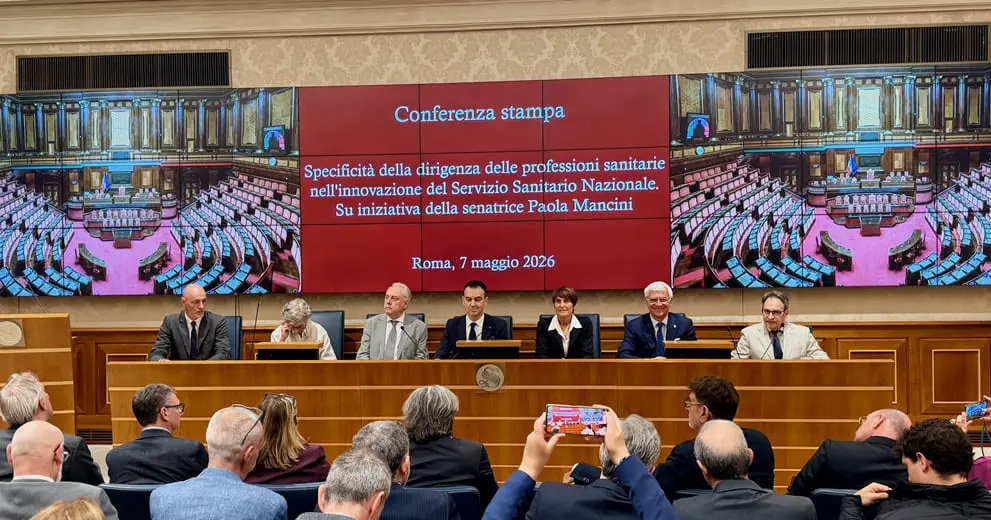
ROMA (ITALPRESS) – Investing in the management of health professions today is a necessary choice to guarantee quality, sustainability and innovation in the National Health Service. It is the warning launched by the National Federation of Orders of Technical Health, Rehabilitation and Prevention (Fno Tsrm and Pstrp), during the event held this morning in the Senate of the Republic. The meeting brought together representatives of the institutions, professionals, academics and industry experts, relaunching the issue of the management of health professions as a strategic hub for the future of health and social organizations. In this context, the indicators emerged from the comparison have evidenced a ratio of 1.7 managers of health professions every 1,000 professionals, faced with European models that stand out on standards between 1 every 50 and 1 every 200. An important difference, therefore, that is reflected also in the territorial distribution of these figures, highlighting marked differences between the different Italian regions, which directly affect the ability of the system to program, coordinate and innovate organizational models.
The Report 2024 of the System for the Evaluation of the Performance of Regional Health Systems of the Scuola Superiore Sant’Anna in Pisa, shows how in the territories where the network of managers is more structured and functional they record better health outcomes and greater efficiency in the provision of welfare services and a good takeover of the assisted persons. “To strengthen the leadership of health professions – said Diego Catania, president of the Fno Tsrm and Pstrp – means to equip the system with a more solid programming capacity, making it more rapid and efficient in responding to the health needs of citizens. It is on this organizational capacity that a decisive part of the estate of the entire Health System is played today.” Three job directors identified. The first concerns the structural development of the management, with the request for full implementation of the model provided for in the legislation: the Legislative Decree 502 of 1992 and Law 251 of 2000, through the establishment of the Departments of Health Professions integrated in the Corporate Strategic Directions. A model considered essential to optimize resources and improve the effectiveness of care, diagnostic, rehabilitation and prevention processes. The second axis concerns contractual adjustment, with the request for an update that fully recognizes the strategic role of management. Among the priorities indicated, the introduction of exclusivity allowances, considered a measure necessary to ensure equal dignity with respect to other health management and to strengthen the stay of professionals in the public system.
The third point concerns the development of skills and leadership. The proposals are based on a system of 11 domains of competence built on the health professions involved. The analysis conducted through the Delphi method by the Federation working group, presented a basic-advanced-executive progression with different levels of application of skills, integration of processes and dynamic governance of systems. Finally, some significant experiences have been presented that document the contribution of the manager of health professions also in the role of socio-sanitary Director, highlighting the important value in the processes of integration and management of services. In addition to these, the theme of the management of the prevention area has been deepened, with a specific focus on coordinating the activities of monitoring, control and protection of collective health, in relation to the increasing complexity of organizational needs and contexts.
During the work, coordinated by Massimiliano Contesini, member of the Central Committee of the Fno Tsrm and Pstrp, the Senator Paola Mancini, promoter of the event, and Mr Ilenia Malavasi, respectively members of the Senate Social Affairs Commission and the Social Affairs Committee of the Chamber of Deputies. They also contributed Massimo Fabi of the Health Commission of the State-Regions Conference, Carlo Bolzonello of the Health Commission of the Friuli Venezia Giulia Region, Professor Federico Lega of the University of Milan and the members of the Group of the National Federation Raffaele Lamanna, Enrica Tidone, Massimo Romanelli and Massimo Mazzieri. The National Federation with this conference intended to underline its willingness to collaborate with the Institutions to translate priorities into normative and contractual interventions, in the awareness that the strengthening of the management of health professions represents an indispensable condition to govern the complexity of the system and accompany its evolution.
– photo press office Fno Tsrm and Pstrp –
(ITALPRESS).