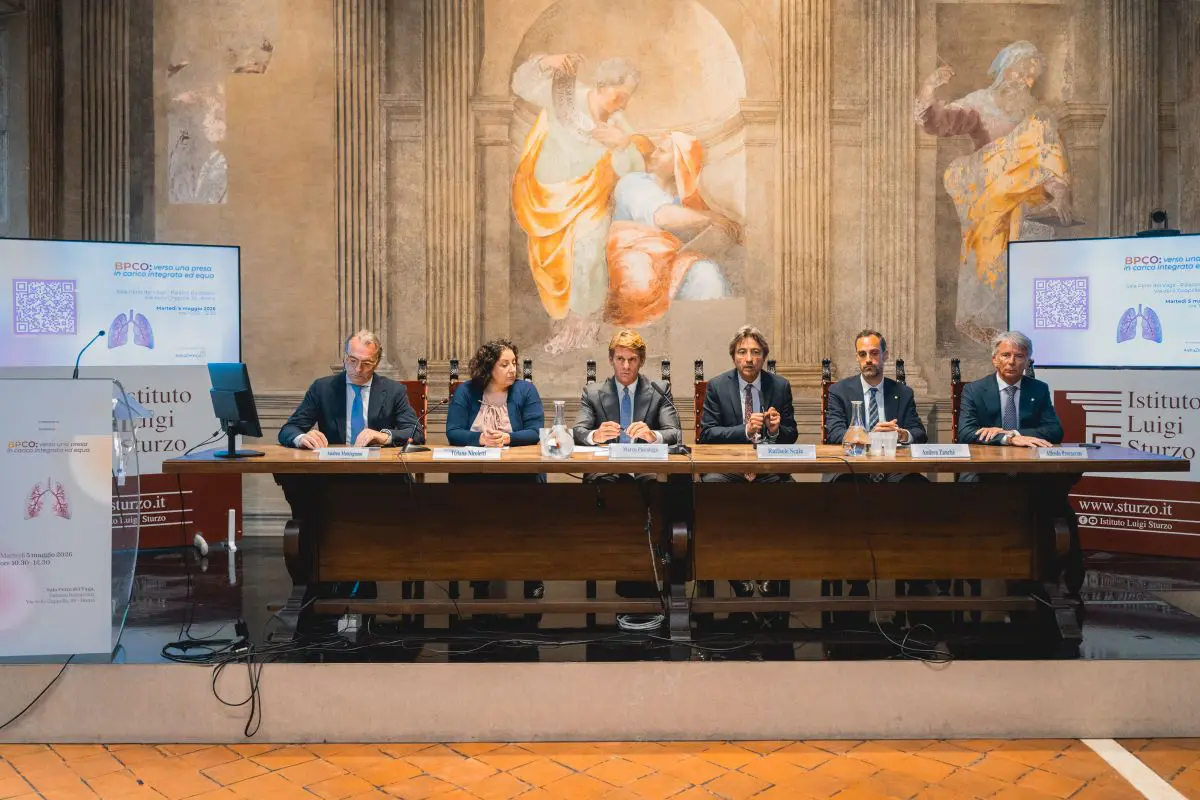
ROMA (ITALPRESS) – The Cronical Ostruttiva Broncopneumopathy, chronic progressive respiratory disease that affects more than 2 million people in Italy, characterized by a growing spread and a high impact in terms of reacutting, hospitalization and health costs, is today a challenge for the National Health Service. These are the themes at the centre of the institutional event “BPCO: towards an integrated and fair grip”, held today in Rome. The initiative, carried out in collaboration with AstraZeneca Italia, which brought together representatives of the institutions, clinical experts, scientific societies and patient associations, provided for the presentation of the policy paper, elaborated by a multidisciplinary Working Group, with the aim of raising awareness on the importance of efficientizing the taking into account for patients suffering from this pathology. Among the main themes reported by patients, and highlighted in the policy itself, there is the criticality of access to care, caused by the prescribed barriers imposed by the Note AIFA n.99, which regulates the prescription of drugs for inhalation therapy for BPCO. Although the Note has been introduced to promote greater integration between specialist and MMG, it is today unable to prescribe triple therapy in one inhaler, considered by scientific evidence, as the most effective for patients with high risk of reacutting. Strong was in this regard the commitment of the Speakers Orfeo Mazzella, Elena Murelli, and Gian Antonio Girelli, who showed great sensitivity on the subject, officially asking for the timely update of the Preliminary Note in order to allow the elimination of the therapeutic Plan for the triple therapy in one inhaler, thus extending the prescription also to doctors of general medicine. In order to ensure an effective treatment path, the need to strengthen the interaction between different levels of assistance has also emerged. The fragmentation between the territory and the specialist affects therapeutic adherence and continuity of care, resulting in an increase in reacuttions and hospitalizations. “It is essential to strengthen the collaboration between general medical practitioner and specialist to optimize patient management with BPCO and ensure a truly integrated grip. It is therefore necessary to foresee the creation of multidisciplinary structured networks, not only between MMG and district specialist, for timely identification and territorial monitoring, but also between the pneumologist and other specialists, regarding the management of serious reacuttions and rehabilitation activities,” said Scala Raffaele, National President of Associazione Italiana Pneumologi Ospedalieri. With regard to the prevention of reacutting, which further complicate the clinical picture of the patient, the importance of therapeutic optimisation has also been stressed, which is the subject of deepening the third chapter of the policy paper. “Who lives with severe COPD – says Paola Rogliani, President of the Italian Society of Pneumology – and goes to meet reacuttions must deal with the worsening of respiratory symptoms and the increase of cardiopulmonary risk. All this results in a significant worsening of the perspective and quality of life. A targeted and personalized therapeutic approach, in line with GOLD Recommendations, is essential: identifying the right therapy for the right patient.” Strong was also the voice of patient associations, which reported the various criticalities that people with BPCO are facing during the patient journey. Salvatore D’Antonio, President of the Association of Patients BPCO and Other Respiratory Pathologies commented “The current limitations of the Note AIFA n.99 continue to represent an obstacle for access to therapies and risk of generare complex routes. In fact, this approach is forcing patients, generally elderly, to resort to specialist visits only for bureaucratic reasons, increasing costs and inconvenience, with expansion of time for the start of therapy, further graving on waiting lists. By modifying Note Aifa n. 99, MMG may prescribe the necessary therapies for patients with the consequence of breaking down inequalities as already occurred in other European countries.” The meeting therefore confirmed the urgency of a systemic intervention that can combine timely access to care, therapeutic optimization and integration between the different levels of assistance, also based on what is provided by the GOLD Recommendations. Only through a strengthening of territorial medicine, a greater collaboration between health professionals and the removal of prescribed barriers generated by the AIFA Note no. 99 will actually be guaranteed the safeguard of the quality of life of patients. -photo press office Esperia Advocacy –(ITALPRESS).