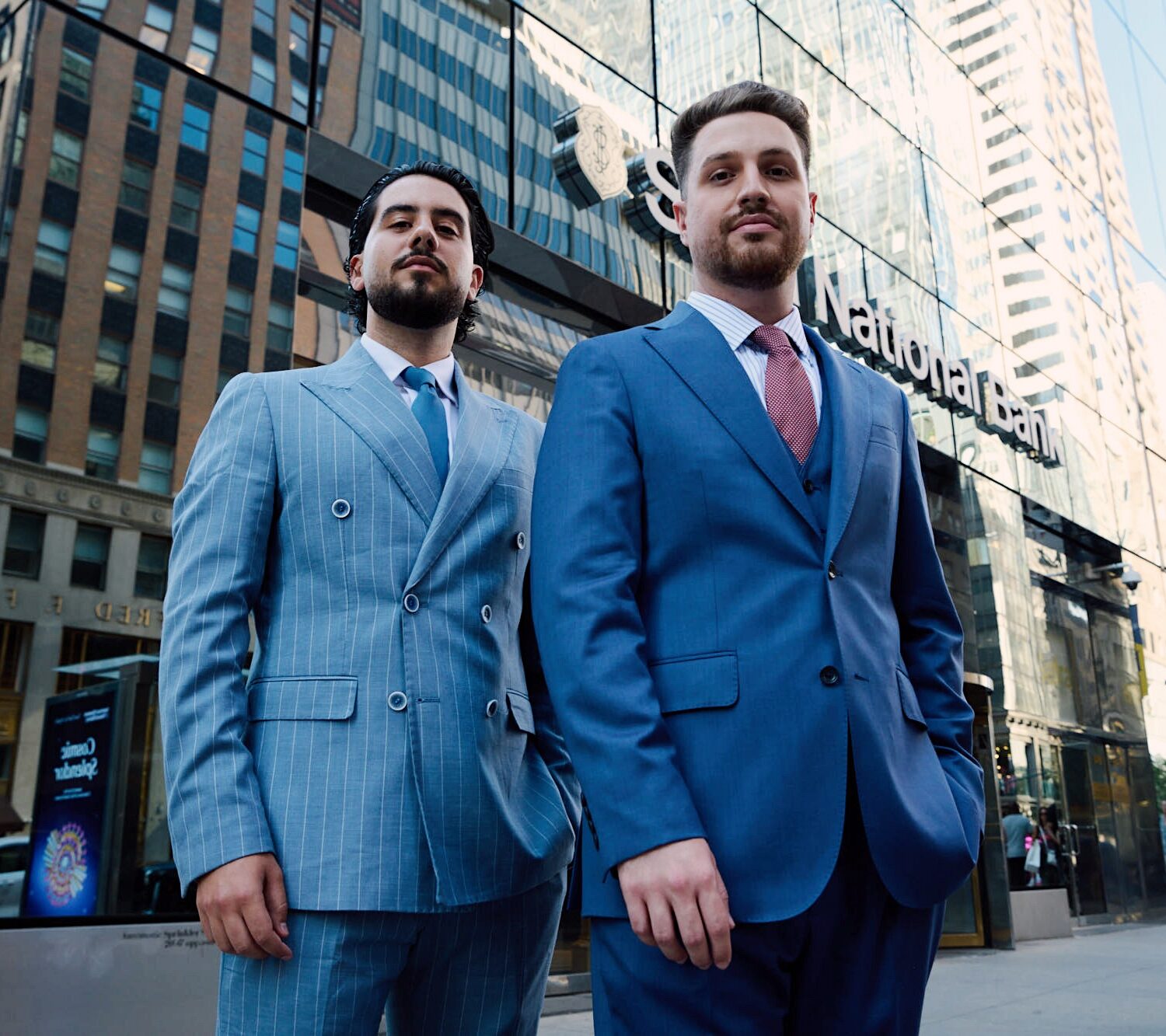
Giovanni Orlando Conti and Rosario Bona arrived in the United States in 2021, with a bachelor’s degree in pocket and the goal of exercising the legal profession in one of the most complex and competitive systems in the world. After a master’s degree at Fordham University and an internship in Aidala, Bertuna & Kamins, they entered the forensic activity between media processes, civil and commercial disputes, and international cases.
In this long conversation they tell their path, the challenges of the American judicial system, the direct experience with customers like Harvey Weinstein and 50 Cent, and the passionate defense of intellectual property in the entertainment world. With a special focus on an open case against Drake for copyright infringement: a case that crosses three continents and still raises crucial questions starting from the 1990s on the relationship between hip-hop, rights and music industry.
Work at Aidala, Bertuna & Kamins. How did your experience begin there?
Rosario Bona: We arrived here in New York in 2021. We were both accepted at Fordham University School of Law, where we did a master’s degree in law, here it is called LLM. The master lasts about a year and a half, and we focused on two areas: the International Business and Trade Law and the Intellectual Property Law, because Fordham gives the opportunity to specialize in multiple areas.
Once graduates, in 2022 we supported the advocacy exam. Already during the studies at Fordham and then after the exam, we started working in the study Aidala, Bertuna & Kamins. Since then we have remained as lawyers associated with the firm.
Lennard Pische
Giovanni Orlando Conti: At first we met the managing partner, Arthur Aidala, celeberrimo for his defensive arrangements in criminal matters and the blason of his clients accused of criminal conduct. As for us, we did not have the idea to devote ourselves to criminal law: it was an opportunity for networking. Arthur’s family is native to a country in the province of Palermo and a few kilometers from Misilmeri, my country of origin – Given the excellent pretext to break the ice, we felt obliged to know it.
One day he told us: “Next week I organize a networking event in a private club whose president I am. Why don’t you come? ” We went, we met so many people: CEO, lawyers representing the world of politics and entertainment. And there we talked to one of the studio partners, Imran Ansari. The conversation immediately turned out to be exciting: we started to discuss how the right can be intersected with the entertainment industry, touching intellectual property issues and legal strategy in creative and media fields. For our part, we shared the strong interest gained during our studies at Fordham and through our independent research, comparing us on some of the most important cases that the study was following in that sector. This meeting was a turning point: from a simple networking event a collaboration was born that today sees us engaged on dossiers of the highest profile.
He said: “You should do an internship with us. ” We kept it in mind, and a few weeks later we called it: “Do you remember? We would like to start an internship from next semester. ” And so it all started, it was 2022. From there we took our place, our desk, our office. And now we’ve been lawyers here since 2023.
What do you do specifically?
Rosario Bona:
We are both part of the Civil Litigation Department of the study and our practice focuses mainly on commercial disputes. We deal with cases ranging from contractual breach to commercial fraud, from disfamation to copyright infringements, to cases of discrimination on work and accidents. We can say that our practice is therefore quite broad.
Giovanni Orlando Conti:
Many of our customers come from the sectors (or industries) of music, cinema, sports and media, or are in any case public figures. We deal with the different legal issues that concern them and which can have a significant impact on their business and reputation. In the United States this type of work is part of the so-called “entertainment law” area, of which we have studied at Fordham and of which the study certainly deals.
Have your academic studies started from Italy?
Giovanni Orlando Conti: Yes. We speak plural because we had the same path. We both started at LUMSA in Palermo.
Rosario Bona: This is the particular aspect.
Giovanni Orlando Conti: At LUMSA we followed the international program, so much of the materials were in English. Then we did three exchange programs: one semester in Krakow, one in New York at St. John’s University – where we also prepared thesis of graduation – and one in Alicante, Spain. So we’ve tested both in English and Spanish.
After graduating in Italy, we did an internship in Warsaw. Then, during the pandemic, we returned to Italy, and then moved to New York to study at Fordham Law.
Lennard Pische
What are the main differences between law study in Italy and the United States?
Giovanni Orlando Conti: The approach is totally different. Here we start from case law, as I think it is known: each case has a history to itself, and you can model your case according to other precedents. The law is more flexible, and the role of the lawyer is more dynamic, I would say even more “divertent”, because it allows you to identify similar judgments, illustrate them to the judge and argue precisely because the cases you mentioned should be applied to your case, or explain how the facts of the preceding presented by the counterpart differ.
The real difficulty however is not so much in the content of the studied subjects. Italian preparation is fierce: you get used to adaptation, to the critical sense. For this reason, many Italians find the most simple studies in America. What is difficult are the exams: in Italy are oral, here often with leiy or multiple response questions. And with very little time available to read, analyze and resolve the fact patterns – i.e. short practical cases that simulate real disputes – even multiple response questions become more challenging than a classic Italian examination.
Was there a case that represented a turning point for you?
Giovanni Orlando Conti:Since the beginning we found ourselves working with customers of international caliber, even people we knew from childhood. One of the first was 50 Cent. We’ve been working on his case right now, and we’ve been in court with him. It was an important experience.
For just over a year we started working closely with Harvey Weinstein. The study takes 360 degrees of its case in New York, both civil and criminal. We take care of his civil cases in particular. Working with a figure of such importance in the world of cinema is for us a professional experience of great value and complexity, as well as an opportunity to closely understand the dynamics of entertainment business. At the same time, prison visits offer us a direct perspective on the American penitentiary system: to meet him, in fact, it is necessary to go to Rikers Island, one of the most severe penitentiaries in the country.
Rosario Bona:I would not say that there was only one case to give the turn, but rather the general activity of the study. As John said, we work for and against very well-known people.
We are very passionate about intellectual property and copyright. We started legal action against world famous singers. We can quote one: we have an active case against Drake for a copyright infringement against our client, a very famous singer.
Among our clients he also featured a professional tennis player who was number one in the world in the WTA ranking. We acted as a local counselor in a very important lawsuit for her that began here in New York.
The study also includes former New York mayors, figures from the world of journalism, entertainment and law.
What would be an example of a particularly important project you have worked on lately?
Rosario Bona: