There are buildings in New York that only follow the market, and others that, quietly, anticipate it. 56 Leonard Street, in the heart of Tribeca, belongs to this second category, and it is no coincidence that, still today, it continues to be one of the most recognizable addresses of the skyline downtown.
For many is the “Jenga Tower”, an almost ironic definition for something that, in reality, is studied with absolute precision. Designed by Herzog & de Meuron, the Swiss study that has transformed contemporary architecture into an artistic language, the building seems to challenge every rule: volumes that overlap without ever really aligning themselves, terraces that display as if they were laid one above the other and a silhouette that changes depending on the light and the point from which you look at it.
It is precisely this apparent imperfection to make it so powerful visually and so rare in a market where often everything tends to resemble.
The first time you enter, the feeling is different from that of many other luxury buildings. There is no “hotel-like” impact that is now found everywhere. At the entrance, Anish Kapoor’s mirror sculpture welcomes residents and visitors with a spectacular reflex game.
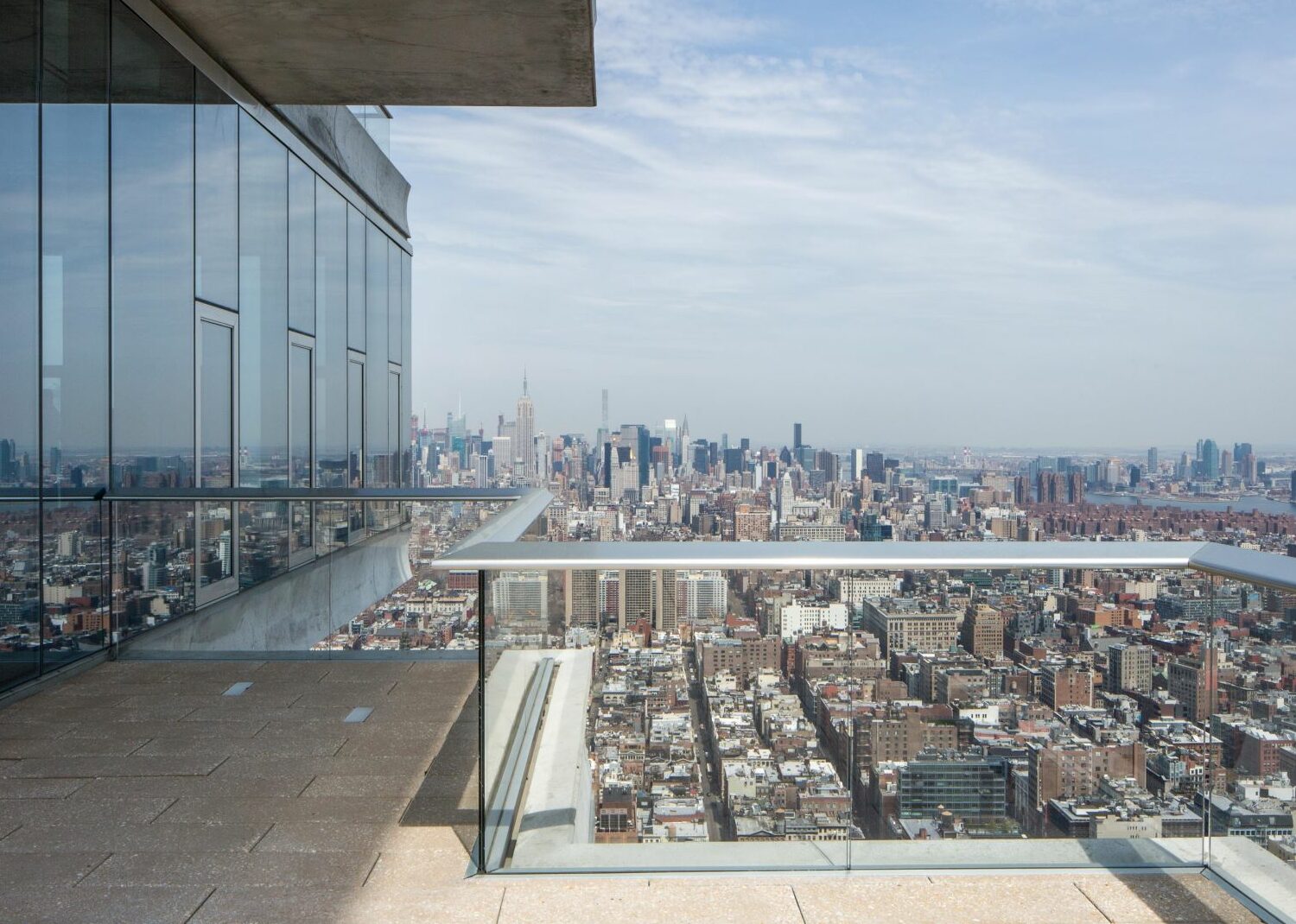
Going up, what really strikes is not only the height, but the way space is lived. The apartments do not follow a repetitive scheme; each unit has its own identity, its own geometry, a unique relationship with light. The terraces, then, are perhaps the most surprising element: not simple balconies, but real extensions of the house, almost outdoor rooms suspended over Manhattan. It is there that often you understand the sense of the building, not so much looking at the city, but suddenly feeling inside it.
In a market like New York, where the concept of luxury is often linked to quantity, more services, more height, more visibility, 56 Leonard Street has chosen a different road. The amenities are, of course, but do not try to impress. Everything is coherent, measured, almost discreet. It is a luxury that does not need to be flaunted.
The type of buyer also reflects this philosophy. Over the years, many of the most important sales, some well over forty million, have not been driven by urgency or speculation, but by the desire to live in something difficult to replicate. It tells an idea of home that approaches collectors.
And then there is Tribeca, made of broad roads, slower rhythms and a quality of life that, in Manhattan, remains difficult to match. It is the kind of neighborhood that does not need to reinvent itself continuously and that, precisely for this reason, remains one of the most solid choices in time.
Maybe that’s why, when I happen to accompany someone to see an apartment here, the conversation changes tone. It becomes less technical, less tied to numbers, and more intuitive. Because there are buildings that explain themselves, and others that understand.
56 Leonard Street definitely belongs to the second category. It is not only a prestigious address, nor simply an example of spectacular architecture. It is one of those rare projects that can shape an idea and keep it intact over time, even while everything around continues to change.
L’articolo 56 Leonard Street, the icon of Tribeca proviene da IlNewyorkese.