Fate sometimes makes sense of irony. Crazy Joe Gallo was born on April 7, 1929 and died on April 7, 1972. Same day, two extremes of the same parable. In the middle: New York, mafia, poetry and a myth that still hasn’t stopped breathing.
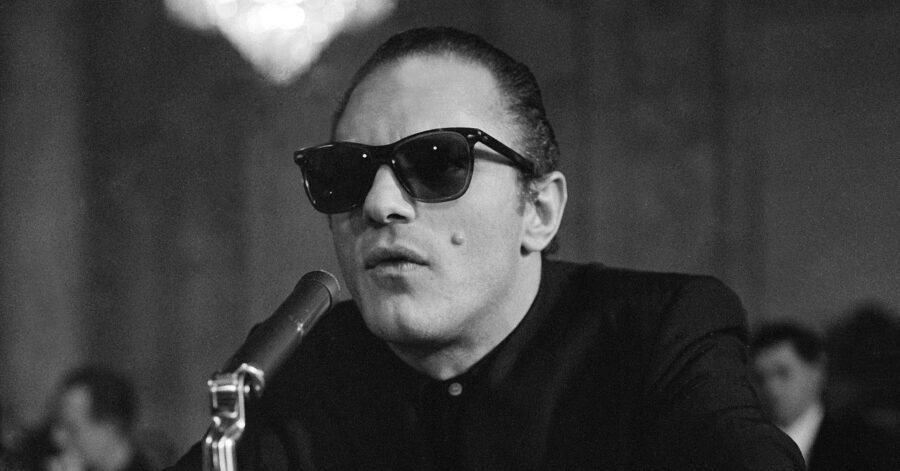
Joe Gallo wasn’t just a gangster. It was an ambiguous, almost romantic symbol of an era in which organized crime merged with culture, street with living rooms, violence with a certain aesthetic of rebellion. And perhaps it is this contradiction that still makes it so fascinating. Already in 1963, during the hearings of the McClellan Commission against organized crime – become central after the revelations of Joe Valachi – presents itself with dark glasses and an almost theatrical attitude: an image that, surprisingly, anticipates the aesthetics of the cinematic mafioso that will come.
To understand Gallo, we must start from the internal war with the Profaci family. In the 1960s, Joe openly challenged his boss, Joe Profaci, breaking balances that seemed untouchable – from there, “Crazy Joe”. It is a dirty war, made of attacks, betrayals and sold. In 1971, the new boss, Joe Colombo – from which the family will take its name – was hit during a public service and will remain in a coma for years, until death. Shooting is Jerome Johnson, an African American, but the main suspect as a warrant is Gallo. Because, for a long time, he had begun to move out of the box, breaking one of the unwritten rules of the mafia: do not involve black people in operations. A cultural taboo that Gallo breaks. And that’s why the suspicions about Crazy Joe become immediate. It was never proven to be him. But in the wild, the verdict arrives before the evidence.
On 7 April 1972, Gallo was killed at Umberto’s Clam House in Little Italy. Spectacular death, almost cinematic. Until then, Little Italy was still an enclave, closed and authentic. After that night, something changes. People start visiting Little Italy not only to taste Italian cuisine, but to see, to breathe the place where “it happened”. It is the beginning of a transformation: from enclave to tourist destination, from district lived to scenography. Curiosity towards the Mafia – until then confined between chronicles and whispers – explodes and will no longer stop.
Il ristorante Umberto’s Clam House dove fu ucciso Crazy Joe Gallo
There is a coincidence that seems written by a screenwriter: The Padrino exits March 24, 1972. Gallo dies exactly two weeks later. Before that, gangsteristic cinema existed, but it had another grammar. There were great classics with James Cagney, such as The Public Enemy, or Scarface by Howard Hawks. Powerful films, but still far from that raw, realistic and at the same time mythological dimension that will explode in the following years. After Gallo’s death – coincidence or not – the crime becomes a global story: the Godfather Part II, those good boys, Scarface by Brian De Palma, Donnie Brasco and many others arrive.
But Crazy Joe’s real peculiarity lies elsewhere, especially in the last years of his life. Not only in the wars of power, but in its dual existence. Thanks to a woman, Gallo begins to attend the West Village, enters the intellectual halls, moves among artists, musicians, writers. He is passionate about Jack Kerouac and the Beat Generation, that idea of instinctive, almost anarchist freedom, which seems to the antipods compared to the rules of the Mafia. That’s where the myth takes shape: a gangster reading, listening to jazz, discussing literature, crossing opposite worlds. It was the Beat Generation gangster.
Over the years, his figure is recounted, transformed and mythized. Films such as Crazy Joe and The Gang That Couldn’t Shoot Straight are directly or indirectly inspired by his life and, more recently, his spirit aleggiates also in Martin Scorsese’s The Irishman or in the Godfather of Harlem and The Offer series. His death also marks the beginning of a collective obsession. The curiosity towards organized crime grows, expands, changes shape. From neighborhood tales you go to books, movies, series, to the current era of true crime.
Crazy Joe Gallo remains an impossible figure to screw up. He was not a classic mafioso and not even a pure rebel: he was something more contradictory, more human. It is born and dies the same day, as a story closed in a perfect circle. And, like all the great stories, it never really stops being told.
L’articolo On April 7, Crazy Joe Gallo was born and died, the Beat Generation gangster comes from IlNewyorkese.