Thinking that a book about Mussolini inevitably belongs to the sphere of academic essay is a prejudice that M. The son of the century of Antonio Scurati denied with decision. In Italy the volume was a major publishing case, won the Strega Prize in 2019 and fueled a broad public debate, because it is not limited to being a historical novel in the traditional sense. In fact, the work combines narrative and documentary reconstruction, woven narrative, articles, vintage sources and archive materials. It emerges a hybrid that many have defined “documentary romance” and that obliges the reader to consider fascism not as a remote and crystallized reality, but as a historical process built progressively, whose implications continue to speak to the present.
One of the most recurring observations in reviews is the book’s ability to return vitality to the past without indulging in any nostalgia. The novel does not propose itself as a simple reenactment, but as a rereading that puts in motion the historical matter and makes it immediately perceptible in its contemporary urgency. The force of the text is to show how that story does not belong only to the national memory, but still interrupt the reader today.
At the heart of Scurati’s narrative operation there is the choice to tell Mussolini’s rise from within. The point of view adopted follows the protagonist in his calculations, in his spreety, in his capacity for political seduction and in the progressive construction of consensus. It is not, however, an attempt to mitigate or justify. On the contrary, the novel proceeds as a true dissection of power and its mechanisms. This is why many critics have read the work as a profoundly anti-fascist intervention: not an abstract condemnation, but the concrete demonstration of how fascism forms, spreads and ends up appearing normal.
One of the most discussed aspects of the book is the principle stated by the author that “nothing is invented”. Uncurati builds the text as a narrative work based on documents, newspapers and historical testimonies. This setting gives the novel a particular tension: when the reader is captured by the rhythm of the story, the weight of the sources constantly recalls it to the reality of the facts. The narration never moves away entirely from the historical ground from which it draws origin.
That’s why M. The son of the century has often been approached to other works that explore the boundary between literary invention and documentary truth. In this case, however, Scurati imprints to the material a proper physiognomy, with a writing that preserves the rigour of the archive but transforms it into narrative energy. The result is a work that, even in its density, possesses a rare drag force.
The novel reconstructs the years between 1919 and 1925, i.e. the phase in which fascism consolidates its grip and Mussolini passes from an emerging figure to a dominator of the Italian political scene. This passage is decisive, because the book does not observe a regime already completed, but follows its training process. Fascism appears not as a monolithic block, but as a gradual construction made up of decisions, complicity, violence and consensus.
Alongside Mussolini, central figures such as Matteotti, D’Annunzio and Balbo move in a choral framework that restores the complexity of the historical context. Fascism, in this perspective, does not appear as the product of a single individual, but as the result of a network of shared interests, ambitions and responsibilities. It is precisely this collective dimension to make the novel particularly effective in clarifying the origins of the phenomenon.
Many reviews insisted that the book illuminates the birth of fascism with both greater and more disturbing accuracy. The regime is not presented as an incomprehensible or unrepeatable anomaly, but as the result of recognizable conditions: social exasperation, political resentment, systematic propaganda, increasing use of violence and progressive public addiction. In this ability to show the genesis of the phenomenon lies one of the reasons why the novel was defined as necessary and current.
Among the most frequent critical observations is the one concerning the start of the book, judged by some particularly dense and sometimes challenging readers. The first pages can give the impression of greater proximity to the essay than to the novel, and the insertion of the documents can sometimes slow the fluidity of the reading. However, many of these same evaluations recognize that, beyond the initial threshold, the text acquires a more tight and engaging pace. Despite the amplitude of the volume, the novel has often been described as a work of strong narrative tension, supported by scenes and dialogues of considerable effectiveness.
The programmatic statement that nothing would be invented inevitably exposed the book to an intense critical scrutiny. Some historians have reported document inaccuracies relating to specific dates, places and details. Ernesto Galli of Loggia, among others, challenged the novel several punctual errors. Scurati has responded by claiming the freedom proper to the romance form, provided that it respects the historical substance. From this comparison a cultural debate of great breadth was born. Yet, even among those who have identified limits or inaccuracies, the recognition of the literary value of the work and its ability to effectively return the political and moral climate of Italy of time has remained firm.
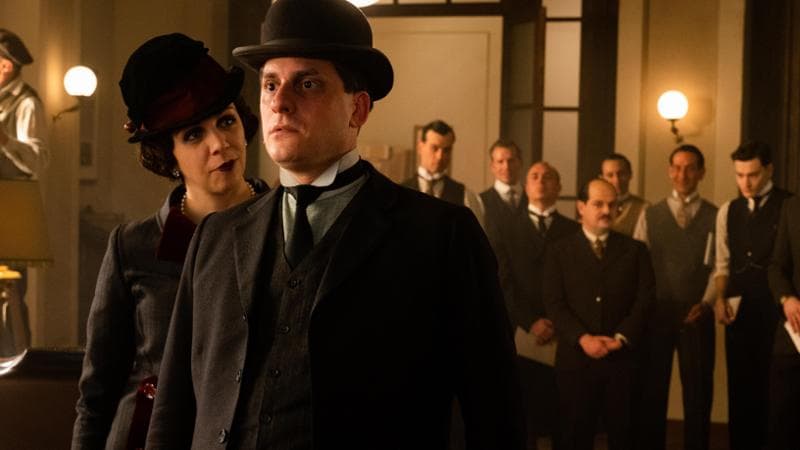
From the success of the novel was also born the series Sky Original directed by Joe Wright, with Luca Marinelli in the role of Mussolini, distributed in the United States also through MUBI. The TV adaptation has accentuated the stylistic dimension and has chosen a visual language strongly contemporary, dark and deforming. Some commentators stressed the deliberately anti-naturalistic nature of the series, accompanied by the soundtrack of the Chemical Brothers, which shifts the perception of the viewer towards a modern nightmare more than a simple historical reconstruction.
The most divisive element of adaptation is probably the breakup of the fourth wall: Mussolini turns directly to the viewer, fixes it, involves it, attempts to seduce it. It is an effective choice in representing power as performance and propaganda as a form of show, but also raises a crucial question. When the protagonist is made so dramatically magnetic, is the final effect a demolition of the myth or, at least in part, a renewed attraction?
The reactions to the series were more contrasted than those recorded by the novel. On the one hand, appreciation for the direction, visual construction and the formal ambition of the project came. On the other hand, there is no lack of criticism of the tone judged excessively grotesque, the freedoms taken regarding the original work and the risk that visual shock ends up prevailing on historical reflection. The Scurati himself expressed reservations about adaptation, fearing that he could alter the anti-fascist core of the book. In this lies the central point of the discussion: the novel enters the logic of fascism to dismantle it, while the series, according to some, runs the risk of transforming that same operation into show.
Adaptation also accentuates violence and insists on a representation of more physical, carnal power and sometimes close to excess. The characters take almost expressionist traits at different times. Where the novel sought to restore a human and historically recognizable tragicity, the series pushes towards a more marked stylization. Some critics, such as Giordano Bruno Guerri, have spoken of forcedness and a spectacularization capable of altering the relationship with reality. The historian Marco Mondini summed up this impression with an expression destined to remain: the “Mussolini Marvel”, that is, a Mussolini built as a cartoon antagonist. For some it is a useful key to clarify that it is not a documentary, but an authorial reading; for others it represents an excessive simplification, potentially prone to producing an involuntary fascination effect.
The comparison between book and series is therefore not easily resolved in a clear preference. The novel offers a powerful reconstruction, supported by documentation and at the same time animated by a strong narrative energy. The series, however, translates that same matter into a popular, perturbanized and strongly stylized visual experience. For some this transformation is a happy intuition; for others a betrayal of the tone and the purpose of the work of departure. In any case, it is not a didactic adaptation, but an interpretation that aims to provoke a reaction and therefore accepts to divide the public.
Maybe that’s exactly why M. The son of the century continues to provoke discussions. The novel, and with it the debate born around its transposition television, is not limited to telling a season ended in Italian history. Rejects that past in circle, removes it from the reassuring distance of memory and forces to observe fascism for what was really: not an abstract monster, but a historical phenomenon born inside the fractures of society, fueled by mechanisms that remain, still today, recognizable.
L’articolo Mussolini, the success of the documentary novel and the series that calls the viewer proviene da IlNewyorkese.