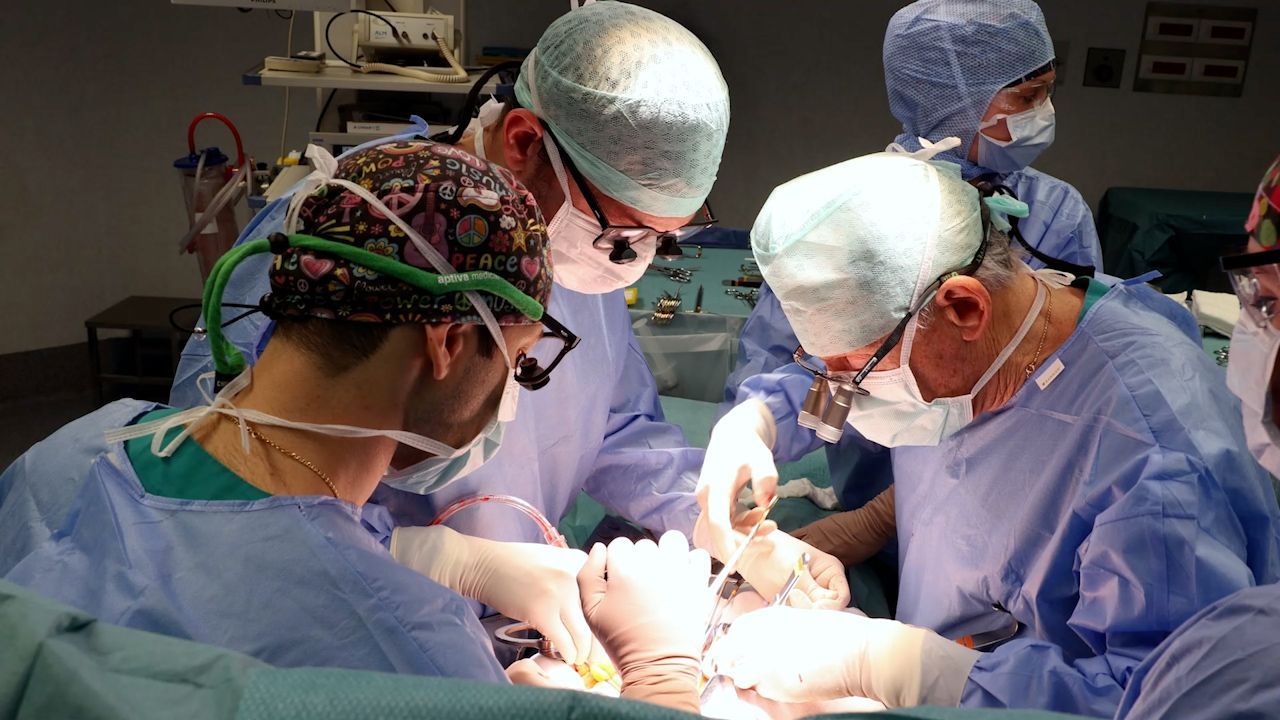
MILAN (ITALPRESS) – The future of vascular surgery moves towards the mini-invasiveness and use of Artificial Intelligence: Professor Roberto Chiesa, head of the Operational Unit of Vascular Surgery of the IRCCCS Hospital San Raffaele in Milan and Ordinary of Vascular Surgery at the Università Vita-Salute San Raffaele. More and more patients, even with complicated or advanced clinical paintings, may be treated for pathologies that concern, for example, complex aneurysms of the thoracic, thoraco-addominal and aortic arc. Moreover, within the Institute, the Aortic Center has recently been established, an interdisciplinary pole of avant-garde with a vocation to clinical innovation and research, confirming the Operational Unit of Vascular Surgery as a national and international reference centre for the treatment of arterial and venous diseases, distinguishing itself particularly in the treatment of aortic pathology. In fact, the team led by Professor Church, also thanks to the presence of a hybrid room of the last generation, can be pioneered in the endovascular approach mininvasive in the presence of aortic aneurysm, or a permanent expansion of the aorta that can become fatal in the event of a break. “Endovascular techniques have absolutely survived traditional surgery in the last twenty years. The big advantage of these techniques – says Prof. Roberto Chiesa – is that it is possible to cure anaurism without laparotomy, that is, without direct surgical access from the abdomen. The techniques in question consist in the introduction, through two small inguinal accesses, of a probe that carries within the aorta an endoprothesis able to expand and until completely exclude the aneurysm from the bloodstream. Here is that aneurysm can no longer break – the professor points out – The big advantage of this procedure lies in its adaptability: It can in fact be applied to elderly people, to people who have respiratory failure, to people who have cardiopathy, to people who cannot support a general anesthesia.” The professor continues: “Today, with these endovascular procedures, it is possible to correct most aneurysms, such as those of aorta, aortic arch and aneurysms to the thoracic aorta. It is no longer necessary to open the chest or abdomen and, above all, it is no longer necessary to use extracorporeal circulation. The first intervention performed at San Raffaele by applying an endovascular technique dates back to 2019: on that occasion we corrected an aneurysm of the arch of the aorta, completely covering the large expansion and thus allowing the patient to survive and avoid the breakage of the aneurysm”. Looking at the perspectives of vascular surgery, Prof. Chiesa explained again: “The future progress will certainly concern the mini-invasiveness: the possibility of increasingly reduced access and with catheters and microcatheters able to reach the increasingly peripheral arteries. In addition, mini-invasiveness, diagnostic phase and programming phase of the intervention, will be increasingly associated with the use of artificial intelligence. This will allow us to read together the patient’s data, in an absolutely perfect and effective way, and to program even more in detail the intervention.” The Vascular Surgery Unit then deals with disorders of visceral vessels, peripheral occlusions, venous diseases and carotid pathologies such as aneurysms and stenosis carotid, that is the narrowing of carotid, one of the most important arteries of the body. “The problems related to the stenosis of the carotid – the professor Church explained – are mainly strokes. It can happen that the plaque, located at the level of the carotid bifurcation, can break and embolize at the level of the brain, reaching a small vase that is occlusive, portani therefore give a high risk of stroke. For this it is necessary to carry out some diagnostic tests to quantize stenosis. Usually a stenosis that needs surgery is around 70%.” – photo IRCCS Ospedale San Raffaele – (ITALPRESS).