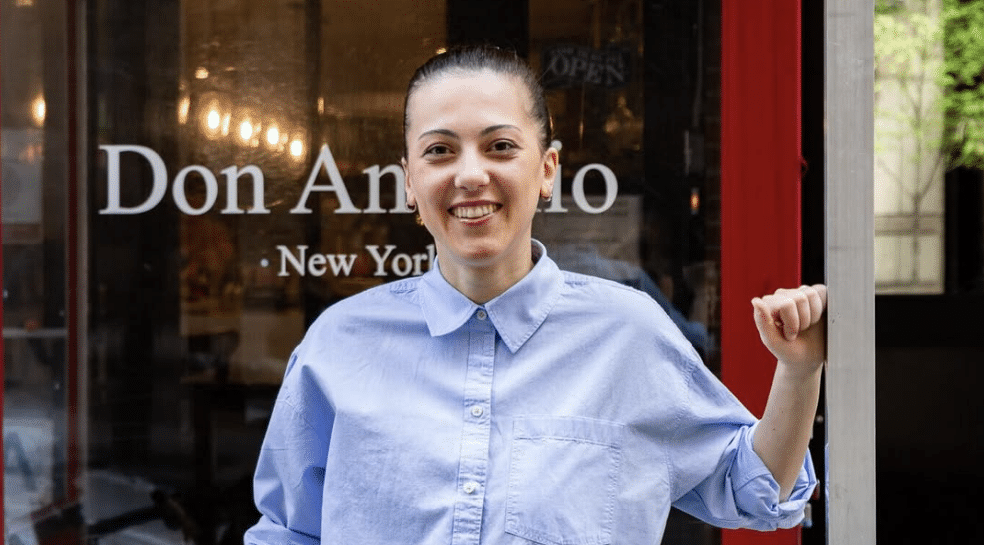
Giorgia Caporuscio is today one of the most authoritative and recognizable voices of the new generation of Italian pizza makers in New York. Entrepreneur, pizzaiola certified and co-founder of Don Antonio pizzerias, Giorgia has been able to build its own professional identity, establishing itself in a historically male sector and carrying out a constant dialogue between tradition and innovation. We interviewed her for New York.
You grew up with a father who is an institution of Neapolitan pizza in America. Do you remember what was a first lesson, technique or life, that transmitted you and that continues to guide you?
Italian fathers of a certain age never really teach you directly. They look at you, they make you do, and at most they say, “Do you understand?”, assuming that the answer is yes. And then, from that moment, you have to do it yourself. In the end, that’s how I learned everything: on the field, observing him every day, working together for many years, mistaken, correcting me and growing slowly. It was a continuous learning, made more than examples of words. With time I have understood very clearly what I like and what I do not like about this job, what aspects I really feel about myself and what instead I struggle to accept. But above all I have learned something fundamental that he has always transmitted to me, perhaps without saying explicitly: humility. Never fit your head, even when things go well, even when awards or success come. Stay with your feet on the ground, respect the work, people and sacrifice behind every result. This, in my opinion, is the most important message I carry behind, both from the professional point of view and from the human and personal. At the same time, from him and from this profession I also learned that you can never stop. It’s a job that obliges you to continually reinvent yourself, to take nothing for granted. You have to change, experiment, create: new pizzas, new concepts, new ways to work. And it is precisely this continuous evolution, in the end, that makes this work alive and that pushes you to move on.
You are one of the few certified pizza women in the United States. What was the biggest challenge to make you space in a historically male sector, and what would you recommend to young women who want to take this path?
Every day, even now, being present in this environment means challenging a consolidated status quo. There are still difficulties in accepting that a woman can be at the same time a professional entrepreneur and pizzaiola. I was lucky: growing professionally in the United States, I had many masters, pizza fathers who believed in me and taught me so much. I have always felt considered myself, but many other girls who have embarked on this career have felt disadvantaged, with the perception that women in this job could not get to the highest levels. Even today, pizza is seen as a “home” craft, while chefs and cooks in the kitchen receive more recognition. There are two main obstacles: the first is linked to the perception between men and women, the second is inside the female world itself, between chef and pizzamaker. In the United States, this dynamic feels even more. Precisely for this reason, before the pandemic in 2019, I pushed to create a group of only women, “Women in Pizza”. Last year he became a non-profit organization along with other pizza makers in the United States, to support new generations. We come from different backgrounds, we make different pizzas, but we share experiences, recipes and techniques. There are no secrets between us, because comparison and mutual help are fundamental. This is a great change compared to what still happens today among many Italian pizza makers, who see their own doughs as secrets to protect. I am currently the first pizzaiola woman with a Neapolitan pizzeria in the Michelin guide in New York City. I couldn’t have achieved these goals alone: the merit is of my team, my husband and two exceptional women managers who support me every day. It is a collaboration at 50 and 50, and without them nothing would be possible.
Your pizzerias are embassies of the real Neapolitan pizza in New York. How do you balance loyalty to tradition and innovation when you create a new pizza or a new dough?
So, I am very close to Don Antonio, who is almost an institution: I can’t change pizzas radically, because customers are very fond, almost like their children. When I eliminate or change a pizza, someone gets angry, so you have to proceed gently. What I do is model the Don Antonio menu with my idea of offer: I try to propose a slightly smaller menu, simpler but careful in detail. After the pandemic, moreover, it became difficult to find some ingredients, so I bet on local products: all vegetables, for example, we take them from nearby farms. This allows us to respect tradition, using ingredients of excellence, but at the same time innovate, creating something unique. For example, there are typical pizzas revisited with my touch: the “Norma” is my version of a Sicilian classic, while the “Ten Year Pizza Anniversary” is my reinterpretation of Margherita, created to celebrate the ten years of Don Antonio. They are small innovations that make the difference: maintain the tradition, the excellence of Italian and local products, but bring a creative element that makes them unique. In this way, I can combine loyalty to tradition and innovation, respecting the history of the pizzeria but adding my personal contribution.
Is there a moment in your career where you realized you really found your voice and identity as a pizzaiola, distinct from your father’s?
Still today I’m trying to get out of my father’s shadow, and it’s not easy at all. It is a huge personality, an extraordinary pizza maker, and growing professionally next to him means constantly measuring with an important legacy. I always say to others: “I’m not just my father’s daughter.” I have a different vision, a different approach to work, but distinguishing myself was not immediate. I think the decisive moment was in 2019, when I went through a real personal crisis. I didn’t want to be in the U.S. anymore, New York no longer excited me, and I lost the motivation for the job. I took a real “burnout” and decided to take a step back, go to school, study and see this craft from a new perspective, more American and more professional. I followed a Culinary & Restaurant Management course in Downtown Manhattan, which opened my eyes. After school, I decided it was time for me to play: I was 30 years old, and I really wanted to build my way. So, in 2020, I picked up Don Antonio, taking the pizzeria, while my father stepped back. Ironically, in February Covid arrived in the United States, and I had to close for two months. Paradoxically, those months of break helped me: They gave me time to understand slowly what I wanted to offer customers and how to bring my figure out. That was the moment when I really realized who I wanted to be like pizzaiola: with my voice, my style and my identity, while remaining faithful to the tradition I inherited.
Looking at the future: What is your professional dream? Open a new place, form a new generation of pizza makers, or maybe bring Neapolitan pizza to another city in the world?
My future is still open to many possibilities. Sure, the pizza will stay in the middle of my life, but I would also like to experience something different, maybe a restaurant that is not exclusively pizza. I have so many projects and ideas, and I want to carefully evaluate what to undertake in 2026 and 2027. The challenge, however, is real: to find pizzaioli willing to work in front of a wood oven, with a certain type of dough, is increasingly difficult. I teach from scratch, but to form new figures is challenging, so for now I think of something simpler, that remains linked to my experience and the tradition of Italian gastronomy, without however being rigid. It could be a place of fries, tapas, or takeaway activity: there are so many possibilities to explore. Another great desire is to teach. I love to convey what I know to others, because teaching always gives me something precious. My father has always valued the training, and even here in New York I had the opportunity to do courses and workshops, involving people of all ages. When we opened Fulton, I pushed a lot on activities for children, because I believe that teaching them the dexterity and importance of food through pizza is fundamental. It is beautiful to see my son go crazy to make pizza: for him is a way of being together with me and learning having fun. So my future dream is twofold: continue to grow with new projects related to Italian pizza and gastronomy, and at the same time form and inspire new generations, perhaps succeeding in doing so full-time and involving more and more people in this world I love.
L’articolo Giorgia Caporuscio, the female voice of Neapolitan pizza in New York proviene da IlNewyorkese.