
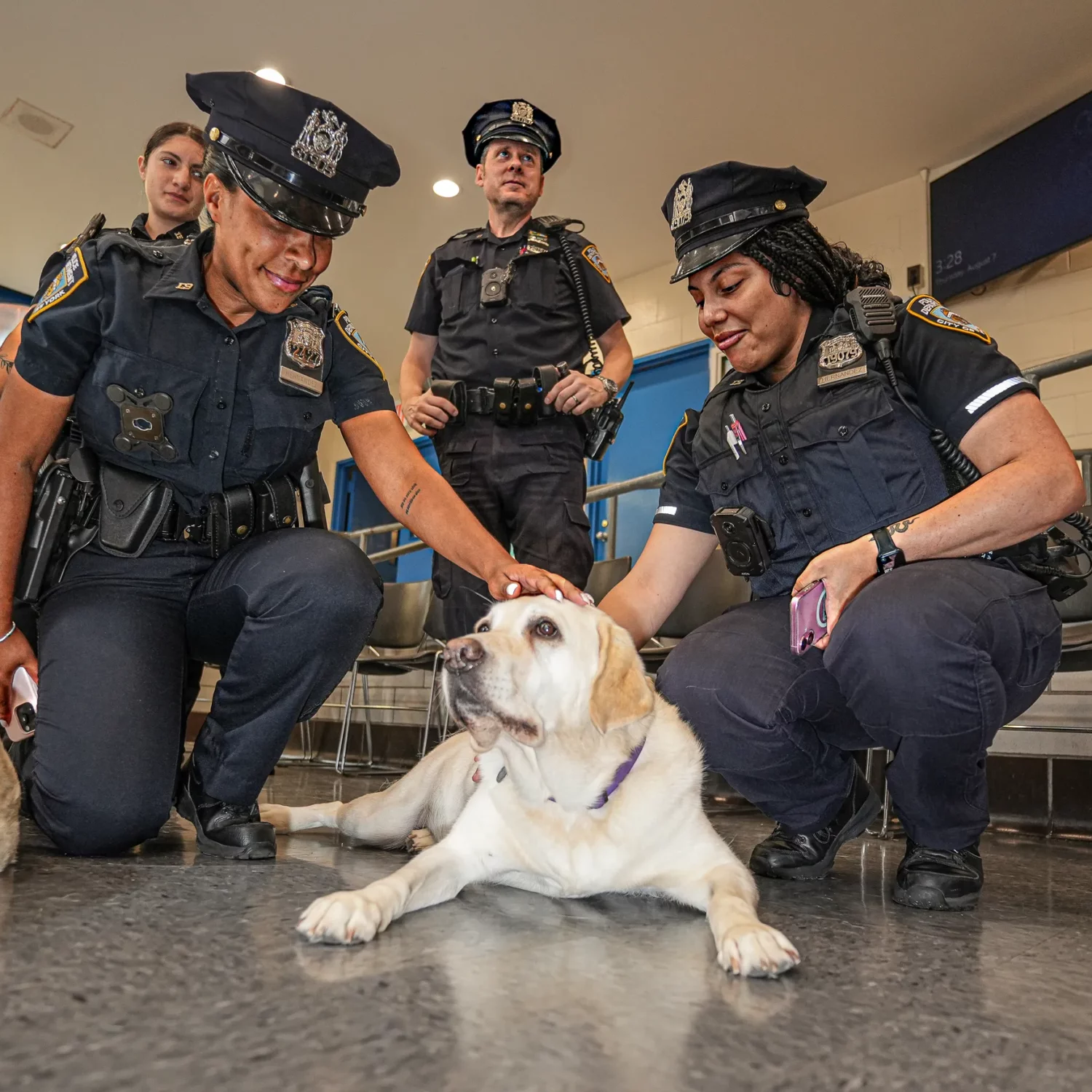
A few hours after the July armed attack on a Park Avenue skyscraper, where a man killed four people, Sergeant Karolina Ostrowska-Tuznik went to the hospital to meet some agents involved in rescues, including those who brought out the building the body of Detective Didarul Islam. With her there was Emma, a 2-year-old black Labrador, one of the dogs used by NYPD in a psychological support unit designed to intervene in critical moments for staff.
Emma and Sergeant Karolina Ostrowska-Tuznik are part of the “wellness unit” of the department that uses so-called facility dogs: dogs trained not for operational activities (such as search for explosives or substances, or pursuit), but to stay beside agents in situations with high emotional impact. The team is activated 24 hours a day after suicides of colleagues, sudden deaths, funerals, or when a command reports that in a district there is a stress level considered worrying. The members of the unit argue that the presence of the dog lowered the defenses and made it easier to talk about anxiety, mourning and burnout, themes that in very hierarchical and “performative” environments often remain under track.
In the last twelve months, however, the programme has been reduced: Two of the four dogs and their conductors retired and there is no immediate plan to replace them. The department lives a phase in which, under Commissioner Jessica Tisch, is pushing to move more staff from office tasks to patrol, with the stated goal of increasing road presence. In a note, NYPD said that it is “standard practice” to review the effectiveness of the programmes and that organizational changes also serve to “restore public trust” and to improve the distribution of agents, citing “crime numbers to the minimum” as a result.
The project was born in the Health and Wellness Section, created in 2019 after ten department agents died of suicide, feeding an internal debate on mental health. In 2021 two Labradors, Jenny and Piper had arrived; in 2024 Emma and Glory had been added and talked about extending the presence with six other dogs distributed in the five districts. Today, instead, the delivery passes are still: after the withdrawal of Piper and his conductor, a dog (Thunder) and an agent had started a two-week training to replace them, but the plan was not approved and Thunder returned to Puppies Behind Bars, the program (managed in a prison in the state of New York) that breeds and training puppies for roles of service and therapeutics and also forms future conductors.
The resize also meets some dynamics within the department: Ostrowska-Tuznik tells that he has asked several times in summer the replacement of retired dogs without receiving an answer, and to be now with his “suspended” position because it is suitable for a promotion to lieutenant, promotion that however – according to what he says – would involve the exit from the unit and return on patrol. On this point he initiated a case against the department and against Tisch, claiming that the condition imposed on her is discriminatory on the gender level, because some men would be promoted without having to leave their respective units. The NYPD argues that postponing on patrol after promotions is a long-standing policy and that in 2025 less than 1 percent of the promoted remained in their department, with exceptions related to specialist units already operating on the field (such as aviation, divers and investigative teams).
Behind the clash there is also a broader discussion about what “comes” in a department with staff shortages: Therapeutic dogs do not stop and solve cases, and this has always been one of the internal objections, according to Kenneth Quick, a former inspector who helped create the unit. But those who defend the project argue that the effect is indirect: reduce the stigma, bring out discomfort before it becomes a crisis, and thus protect the operational capacity of the department to ensure that arrests and cases are resolved by healthy humans – and not by dogs.
Each dog costs about $60,000 training, covered through a partnership between Puppies Behind Bars and the New York City Police Foundation. Ostrowska-Tuznik, meanwhile, says that even if she was expected to hold Emma as a pet in case of transfer, the point for her is another: the risk is that, with additional pensions, only one operating dog remains and that the whole project is actually emptied.
L’articolo The therapy dogs unit in NYPD to reduce burnout and suicide by agents proviene da IlNewyorkese.